Best yoga stretches for stiff office workers

The best yoga stretches for stiff office workers are cat-cow, low lunge, figure-four, puppy pose, and thread-the-needle because they target the spine, hips, shoulders, and ribs most affected by desk work.
At 3:17 p.m., your body starts telling the truth.
Slowdive is a calm-tech companion — guided meditations, breathing practices, and sound therapy crafted for everyday balance.
Your inbox says “quick question.” Your calendar says “sync.” Your upper trapezius has been parked near your ears since breakfast. You stand up for water and your hip flexors need three seconds to remember that walking is not a software update.
That’s the office-worker body. Not broken. Just under-moved for six or seven keyboard-heavy hours.
The best yoga stretches for stiff office workers are usually not the dramatic ones you see on a beach at sunrise. They’re the quiet, useful ones: thoracic flexion and extension from cat-cow, hip-extension work from low lunge, shoulder flexion from puppy pose, and an outer-hip release from figure-four.
Yoga is not a fringe habit in the United States anymore. In the 2017 National Health Interview Survey, 14.3% of U.S. adults reported practicing yoga in the previous 12 months, up from 9.5% in 2012 (Clarke et al., 2018). But you don’t need a studio membership or a 60-minute vinyasa class to get the useful part.
You may need ten minutes. Maybe twelve.
And you need stretches that match the problem: 90-degree hips from sitting, forward-reaching shoulders from typing, limited thoracic rotation from screen focus, and a nervous system that may have been “on” since your first Slack notification. That’s where simple yoga stretches and yoga stretches for beginners can be more useful than anything dramatic.
Find your meditation match in 60 seconds
Why office stiffness feels so sticky

Most office stiffness comes from repetition: hips flexed at 90 degrees, elbows bent over a keyboard, cervical spine drifting toward a monitor, and rib cage barely moving while you answer email.
You sit with your hips bent. You reach your arms forward. Your upper back rounds a little. Your head drifts toward the screen. Your wrists hover over a keyboard. Then you repeat that same musculoskeletal loop tomorrow.
U.S. adults’ average daily sitting time increased from 5.5 hours in 2007 to 6.4 hours in 2016 in a JAMA analysis of National Health and Nutrition Examination Survey data (Yang et al., 2019). If you work at a computer, that 6.4-hour estimate can feel generous.
Here’s the useful part: stretching doesn’t have to “undo” your whole day to be worthwhile. A good stretch can give your body a different input. Cat-cow gives your spine flexion and extension after hours of stillness. Low lunge may help the iliopsoas and rectus femoris move out of a shortened sitting position. Puppy pose asks your shoulders to move into flexion instead of keyboard reach.
Small, done often, often beats heroic and rare; a 60-second side bend at 2 p.m. is more realistic than a perfect 75-minute class you never start.
How to use the best yoga stretches without turning it into a project
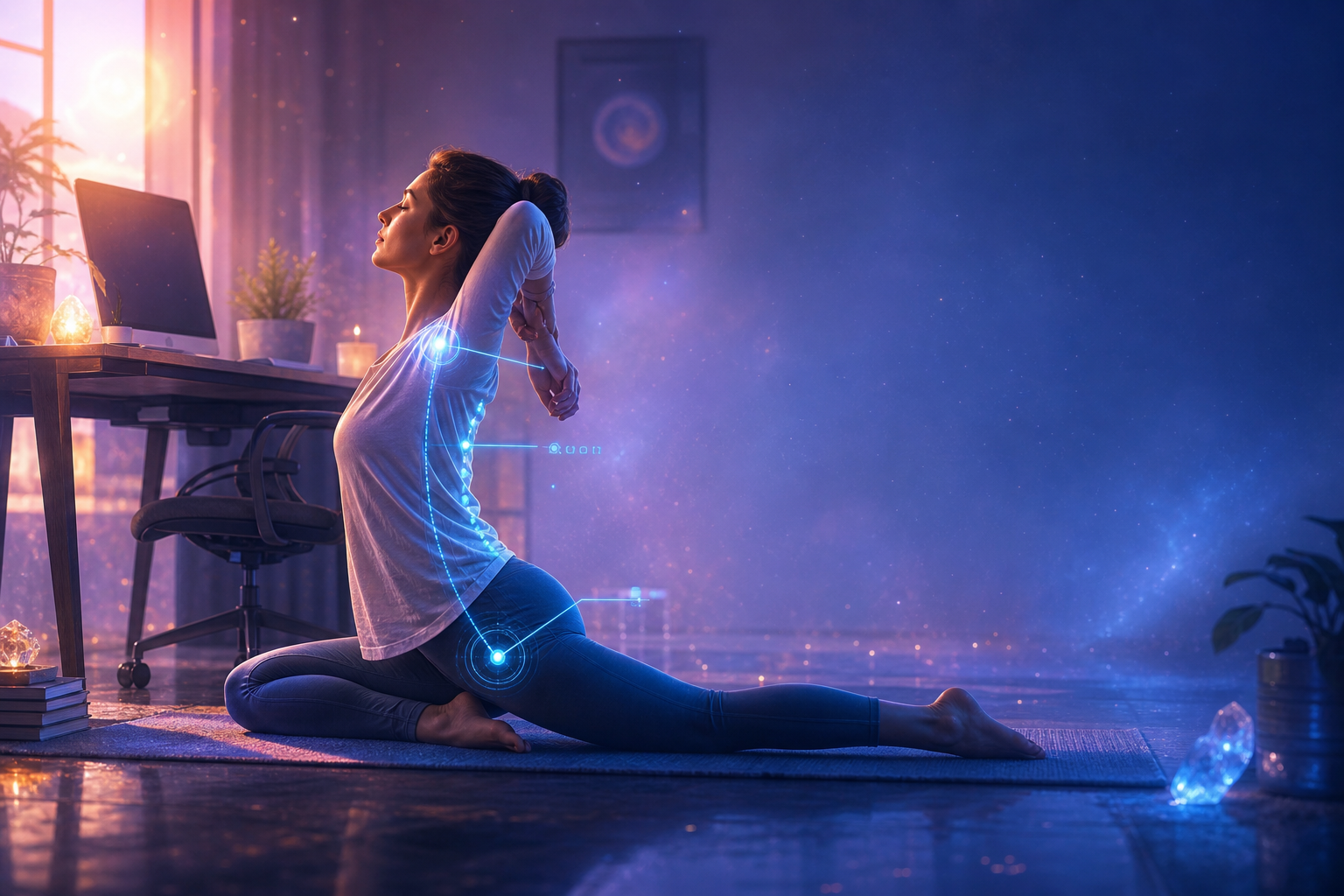
Use three rules before the poses: move slowly, breathe through your nose if comfortable, and keep most holds in the 30- to 60-second range.
Hold most stretches for 5 to 8 slow breaths. If a stretch feels sharp, electrical, or makes symptoms travel down an arm or leg, stop. If you have a recent injury, unexplained numbness, or pain that keeps worsening, consider talking with a qualified healthcare professional before trying to stretch through it.
You should feel a clear sensation around a 4 to 6 out of 10. You should not feel like you’re negotiating with your survival instinct.
Breathing matters because exhalation may help downshift the system you bring into the stretch. Slow breathing practices have been linked with changes in heart rate variability and autonomic nervous system activity in a 2018 review by Zaccaro and colleagues (Zaccaro et al., 2018). In plain English: the breath can be one way to tell your body, “We’re not being chased by the quarterly report.”
Use the ten stretches below as a menu, not a personality test.
1. Cat-cow: one of the best yoga stretches for the spine that forgot it could move
Cat-cow moves your spine through flexion and extension: rounding the thoracic spine on the exhale, then gently extending through the chest on the inhale. It belongs with the best yoga stretches because it gives a desk-stiff back two clean movement options quickly.
How to do it on the floor:
- Come to hands and knees.
- Place your wrists under your shoulders and knees under your hips.
- Inhale and drop your belly slightly as your chest moves forward. This is cow.
- Exhale and round your back, letting your head and tailbone soften down. This is cat.
- Move for 8 to 12 rounds.
Don’t crank your neck. Let your cervical spine follow your rib cage instead of leading the pose.
Desk version: Sit tall with both feet on the floor. Place your hands on your thighs. Inhale, arch gently, and lift your sternum. Exhale, round your back and draw your navel slightly in. It looks like nothing. For many people, it helps.
This is the stretch I’d choose if you only had one minute between Zoom meetings.
2. Low lunge: one of the best yoga stretches for tight hip flexors
If sitting had a signature muscle complaint, it would be the front of the hips: iliopsoas, rectus femoris, and the crease where your thigh meets your pelvis.
Low lunge stretches the hip flexors, especially the tissues held short when your thighs stay folded toward your torso for hours. For yoga for stiff hips, this is one of the best yoga stretches to start with because it encourages hip extension without requiring a dramatic backbend.
How to do it:
- Start on hands and knees.
- Step your right foot forward between your hands.
- Slide your left knee back a little and rest the top of the left foot on the floor.
- Bring your hands to your right thigh or blocks.
- Gently tuck your tailbone under, just enough to avoid dumping into your low back.
- Breathe for 5 to 8 breaths, then switch sides.
The common mistake is chasing depth. People shove the hips forward and arch the lumbar spine. Try not to. Keep the stretch in the front of the back hip, not in your low back.
Office version: Stand beside your desk. Step one foot back into a short lunge, bend the front knee, and keep both hip points facing forward. Slightly tuck your pelvis. Hold the desk for balance.
This 30- to 60-second office lunge is quiet, useful, and mat-free.
3. Half split: one of the best yoga stretches for hamstrings that feel like old guitar strings
Hamstrings get blamed for everything, unfairly. But if the backs of your legs feel tight when you bend to tie your shoes, half split gives the hamstring group, biceps femoris, semitendinosus, and semimembranosus, a controlled way to lengthen.
It’s less aggressive than a standing forward fold and easier to control because your hands, blocks, or books can take some load. That makes it one of the best yoga stretches for beginners who want hamstring relief without forcing the lumbar spine into a rounded shape.
How to do it:
- Begin in low lunge with your right foot forward.
- Shift your hips back until your right leg straightens or mostly straightens.
- Flex your right foot so the toes point up.
- Keep a long spine as you fold slightly over the front leg.
- Use blocks, books, or your fingertips on the floor for support.
- Hold for 5 to 8 breaths, then switch.
You do not need to straighten the front leg completely. A 10- to 20-degree bend in the knee often makes the stretch feel better because you can keep your pelvis tilting forward instead of rounding your back.
Desk version: Place one heel on a low chair or sturdy footrest. Flex the foot. Hinge from the hips with a long spine until you feel the back of the thigh.
If you feel the stretch behind the knee more than in the hamstring belly, soften the knee and reduce the hinge.
4. Figure-four: one of the best yoga stretches for glutes and outer hips
Figure-four is the desk-worker stretch many people remember because it targets the outer-hip area that often gets grippy after long sitting spells.
The figure-four stretch targets the gluteal region and deep external rotators around the hip, including the piriformis area. It’s also one of the best yoga stretches for people who find pigeon pose too intense, and it fits beautifully into yoga for stiff hips.
Chair version first, because it’s excellent:
- Sit near the front edge of a sturdy chair.
- Put both feet flat on the floor.
- Cross your right ankle over your left thigh, making a “4” shape.
- Flex the right foot to protect the knee.
- Sit tall, then hinge forward slightly from your hips.
- Hold for 5 to 8 breaths, then switch.
Keep the lifted foot active so the ankle and knee stay organized. If your knee complains, back off or skip it.
Floor version:
- Lie on your back.
- Cross your right ankle over your left thigh.
- Thread your hands behind the left thigh and draw the legs toward you.
- Keep your head and shoulders relaxed.
This one pairs well with six-count exhales. It can give your body a clear message: we’re done bracing now.
5. Thread-the-needle: one of the best yoga stretches for upper back and shoulders
Office posture tends to make the upper back feel like a single slab because the thoracic spine spends the day rounded and under-rotated. Thread-the-needle brings rotation back into the picture.
It also stretches around the posterior shoulder, where desk tension often hides between the shoulder blade and rib cage. For yoga for tight shoulders, this is one of the best yoga stretches because it moves the upper back without asking the neck to do all the work.
How to do it:
- Start on hands and knees.
- Slide your right arm under your left arm, palm facing up.
- Let your right shoulder and the side of your head rest on the floor, a blanket, or a block.
- Keep your hips roughly over your knees.
- Breathe into the space between your shoulder blades.
- Hold for 5 to 8 breaths, then switch.
If the floor feels far away, put a cushion under your shoulder. If your knees hate the floor, do the chair version.
Chair version: Sit tall. Cross your arms over your chest, hands on opposite shoulders. Rotate gently to the right for a few breaths, then to the left. Keep your hips facing forward.
The goal is not to force a twist. The goal is to stop living only in straight-ahead monitor mode.
6. Puppy pose: one of the best yoga stretches for chest, shoulders, and the “laptop hunch”
Puppy pose looks innocent. Then you do it after six hours on a laptop and suddenly your armpits, lats, and triceps may have opinions.
This pose stretches the shoulders, chest, and sides of the body while keeping the hips lifted. It can feel intense, so use a block, pillow, or chair without pride. It’s one of the best yoga stretches for yoga for tight shoulders, especially when your day has been mostly screen-shaped.
How to do it:
- Start on hands and knees.
- Keep your hips stacked over your knees.
- Walk your hands forward.
- Let your chest soften toward the floor.
- Rest your forehead on the mat, a block, or a folded towel.
- Hold for 5 to 8 breaths.
If your shoulders pinch, widen your hands or bend your elbows. You can also rest your elbows on a chair seat and step back until your torso lengthens.
Desk version: Stand facing your desk. Place your hands on the desk, walk your feet back, and fold until your torso is roughly parallel to the floor. Bend your knees slightly. Let your chest sink gently.
This can be a practical mid-afternoon reset because it changes the laptop shape: shoulder flexion instead of forward reach, a longer spine instead of a collapsed rib cage.
7. Doorway chest stretch: one of the best yoga stretches for the front body
The doorway chest stretch is barely yoga, and I’m including it anyway because it directly addresses the pectorals and front shoulders.
A doorway chest stretch opens the pectoralis major, pectoralis minor, and anterior shoulder line. If you spend the day reaching toward a keyboard, mouse, phone, steering wheel, or child, this stretch may belong in your life. It earns its place among the best yoga stretches because office posture is often a front-body problem.
How to do it:
- Stand in a doorway.
- Place your right forearm on the doorframe with your elbow around shoulder height.
- Step your right foot forward slightly.
- Turn your chest away from the arm until you feel a stretch across the front of the shoulder and chest.
- Hold for 5 to 8 breaths, then switch.
Keep your ribs from flaring forward. Think “sternum tall, jaw soft, low ribs quiet.”
For a gentler version, lower the elbow below shoulder height. For a stronger version, place the arm a little higher, but don’t chase the biggest sensation. Bigger is not always better for the anterior shoulder.
8. Seated side bend: one of the best yoga stretches for compressed ribs and shallow breathing
A stiff office body is often a narrow-breathing body: ribs barely moving, diaphragm crowded, upper chest doing more work than it needs to.
Curious about where to begin? A short check-in maps your stress baseline and suggests a personalised practice plan.
When your ribs barely move, your breath may stay high and small. A seated side bend gives the intercostal muscles and side ribs some space. It’s simple enough to do before a call, and it may help you breathe a little more fully in under a minute. That’s why it belongs with the best yoga stretches for desk worker stretches.
How to do it:
- Sit tall with both feet grounded.
- Place your right hand on the chair or your thigh.
- Reach your left arm overhead.
- Lean gently to the right without collapsing forward.
- Breathe into the left side of your ribs for 3 to 5 breaths.
- Switch sides.
Try not to turn the side bend into a performance. The point is not how far you lean. The point is whether you can breathe into the stretched side ribs for three slow breaths.
I like this one before a difficult conversation because the rib-cage movement gives your body something specific to do besides brace.
9. Modified downward dog: one of the best yoga stretches for real wrists and real hamstrings
Downward dog is famous for a reason, but the standard version can be rough if your wrists, shoulders, calves, or hamstrings are tight. So modify it.
The office-worker version should feel like a long stretch through the posterior chain, calves, hamstrings, back, and shoulders, not a punishment. Modified well, it can be one of the best yoga stretches for people who want length without drama.
How to do it:
- Start on hands and knees.
- Spread your fingers wide.
- Lift your hips up and back.
- Bend your knees generously.
- Press the floor away and lengthen your spine.
- Let your heels move toward the floor, but don’t force them down.
- Stay for 3 to 6 breaths.
If your wrists are cranky, do puppy pose at the desk instead. If your shoulders feel jammed, bend the knees more and shorten the stance.
Downward dog should give your spine space. If it makes you clench your teeth by breath three, pick another stretch.
10. Wrist and forearm stretch: one of the best yoga stretches for keyboard hands
Your hands do a ridiculous amount of work for very little praise: typing, scrolling, clicking, gripping coffee, and answering messages while walking.
The wrists and forearms deserve a reset because the finger flexors and extensors spend hours making tiny keyboard and mouse contractions. These simple yoga stretches count, too; the best yoga stretches are the ones your actual day asks for.
How to do it:
- Sit or stand tall.
- Extend your right arm forward, palm facing up.
- With your left hand, gently draw the right fingers down and back.
- Hold for 3 to 5 breaths.
- Turn the palm down and gently draw the fingers toward you for the top of the wrist.
- Switch sides.
Keep it light. The wrist joint is not a place to prove your toughness.
For a yoga-style version, come to hands and knees and turn your fingers slightly out to the sides, then gently shift your weight in small circles. If that feels too strong, stay seated and use the 3-breath version.
A 12-minute best yoga stretches sequence for stiff office workers
This is the weekday routine I’d actually do: 12 minutes, one mat or clear patch of floor, no incense, no outfit change.
Minute 0 to 1: Slow breathing
Sit or lie down. Inhale through your nose for 4 counts. Exhale for 6 counts. Do that 6 times.
Minute 1 to 3: Cat-cow
Move through 10 slow rounds. Let your breath set the pace.
Minute 3 to 5: Low lunge
Hold right side for 6 breaths. Hold left side for 6 breaths.
Minute 5 to 7: Half split
Right side, then left side. Keep the spine long.
Minute 7 to 9: Thread-the-needle
Right side, then left side. Let the exhale soften the upper back.
Minute 9 to 10: Puppy pose
Use a pillow or block under your forehead if needed.
Minute 10 to 12: Figure-four on your back
Right side, then left side. Let your shoulders drop.
That 12-minute block can be enough for a stiff-office-worker reset.
If you have only five minutes, do cat-cow, low lunge, puppy pose, and figure-four. If you have only one minute, do seated cat-cow and a side bend at your desk. The best yoga stretches routine is the one you can repeat without making it another project.
A repeated 5-minute lunch pattern often beats perfect sequence design.
How hard should the best yoga stretches feel?
Use a 1 to 10 scale for stretch intensity.
A 1 is nothing. A 10 is “get me out of here.” Most stretching should live around a 4 to 6. Clear sensation. Steady breath. No bargaining.
If your face tightens, your breath gets choppy, or you start counting seconds like you’re defusing a bomb, reduce the intensity by 20% and see if your exhale comes back.
There’s a strange maturity in doing less. Beginners often stretch too hard because they think intensity equals progress. Stiff office workers usually need permission, not aggression. Even the best yoga stretches stop being useful when you turn them into a contest with your hamstrings.
Morning, lunch, or evening?
Pick the 10-minute slot you’ll repeat.
Morning stretching can make the first hour at your desk feel less creaky. Lunch stretching interrupts the sitting pattern before your body gets resentful. Evening stretching may help mark the end of work, especially if your office is also your kitchen table.
I like lunch for practical reasons. Your body has enough warmth to move, and the routine creates a clean break in the day. Ten minutes away from the screen can feel oddly rebellious.
If you’re anxious, pair stretching with a breath count. Inhale for 4. Exhale for 6. Keep it boring. Boring is underrated. The best yoga stretches are the ones you can do at the same boring time tomorrow.
What about back pain?
Yoga is not a magic eraser for back pain, and any article that promises otherwise is selling something too shiny.
Yoga has been studied for chronic low back pain. A 2017 Cochrane review by Wieland and colleagues found low- to moderate-certainty evidence that yoga produced small to moderate improvements in back-related function at 3 and 6 months compared with no exercise (Wieland et al., 2017). That doesn’t mean every pose is right for every back. It means a gentle, consistent practice can be a reasonable part of the picture for some people.
For stiff office backs, start with cat-cow, figure-four, supported low lunge, and side bends. The best yoga stretches for back comfort are usually the supported ones first. Be cautious with deep forward folds first thing in the morning, especially if they make your symptoms worse.
Your body gives feedback through breath, range, and symptom location. Listen at the first whisper, not after it has to shout.
The tiny habit that makes the best yoga stretches work
Don’t promise yourself an hour of yoga every day. That’s how the mat becomes another object you feel guilty about.
Attach one stretch to something already in your day.
After your first coffee: seated side bend.
After your 11 a.m. meeting: doorway chest stretch.
Before lunch: low lunge.
When you close the laptop: figure-four.
One stretch done daily is usually better than an ambitious routine you avoid. Once your body trusts the routine, it may start asking for more. Not in a mystical way. In the ordinary way that your shoulders drop at 4:30 p.m. and you think, “Oh. I needed that.”
A final word for the person who feels too stiff for the best yoga stretches
You are probably not too stiff for yoga stretches.
You may be exactly who they’re for.
Use a chair. Use the wall. Bend your knees. Put a pillow under your head. Skip the pose that annoys your body and choose the one that helps. You don’t need to look graceful. You need to feel a little more at home in your own frame after a long day of tabs, pings, and posture you didn’t choose consciously.
Start small today. Choose three: cat-cow, low lunge, figure-four. The best yoga stretches for stiff office workers can begin there.
If you want help making it feel less like another task, open Slowdive and use the guided breathing timer before your stretch sequence. Set it for 10 minutes, choose a slow exhale pace, and let the timer hold the structure while you give your body a different kind of work. When you’re ready to find a practice that fits your day, Find your meditation match.
FAQ about the best yoga stretches
What are the best yoga stretches for beginners who sit all day?
The best yoga stretches for beginners who sit all day are often cat-cow, low lunge, seated side bend, doorway chest stretch, and chair figure-four. They are simple yoga stretches, but they cover the main office patterns: rounded thoracic spine, shortened hip flexors, compressed ribs, and grippy outer hips.
How often should I do the best yoga stretches for office stiffness?
Do the best yoga stretches as often as you can repeat them without turning them into a chore. Ten to twelve minutes most weekdays is plenty for many people. If that feels too much, attach one stretch to coffee, lunch, or closing the laptop. Small, done often, usually beats heroic and rare.
Can desk worker stretches help tight shoulders?
Desk worker stretches can help tight shoulders when they move the upper back, chest, and ribs, not just the neck. Thread-the-needle, puppy pose, doorway chest stretch, and seated side bend are good choices. For yoga for tight shoulders, keep the breath steady and avoid forcing shoulder range.
Is yoga for stiff hips different from regular stretching?
Yoga for stiff hips usually asks for patience and support, not just a hard pull. Low lunge helps the front of the hips, especially the hip flexors, while figure-four helps the outer hips and glutes. The best yoga stretches for stiff hips should feel clear, steady, and easy to back out of.
Should the best yoga stretches hurt to work?
The best yoga stretches should not hurt. Aim for a 4 to 6 out of 10: noticeable sensation, relaxed face, steady breathing. Sharp, electrical, spreading, or worsening symptoms are a reason to stop. Stretching often works better when your body feels safe enough to soften.
Sleep stories, breathing routines, and curated sound healing tracks — built for evening wind-downs and morning resets.