
Body scan mindfulness script for beginners


A body scan may help by giving attention a sequence, not a blank stage.
A body scan is one of the least dramatic mindfulness practices I know. You move attention through the body, usually from feet to head or head to feet, and notice sensory data: warmth, pressure, tingling, numbness, irritation, the seam of a sock pressing into the fourth toe.

That’s the practice: interoception without interrogation.
Not fixing the body. Not floating away. Not becoming the kind of person who owns a linen robe and says “nourish” without flinching. Just noticing sensation before the mind turns it into a verdict.
Below, you’ll find a beginner-friendly body scan mindfulness script you can read to yourself, record in your own voice, or use to guide someone else. Think of it as a body scan meditation script with room for real life: a 10-minute version, a 5-minute version, a 3-minute desk scan, and practical notes for wandering thoughts, discomfort, blank areas, and falling asleep halfway through.
Because you might fall asleep during minute 7.
And that’s fine.
Find your meditation match in 60 seconds
Why the body scan works for beginners
For many beginners, a body scan mindfulness script can feel easier than breath meditation because attention has multiple “stations” instead of one narrow target. A lot of meditation instructions start with the breath. For some people, that’s useful. For others, especially anxious beginners, “focus on your breath” can feel like being asked to manually operate the diaphragm.
The body scan gives the mind a route: toes, soles, ankles, calves, knees, thighs. That sequencing may matter. Instead of trying to hold attention on one small object for 10 minutes, you redirect attention every few breaths, which gives a restless mind a concrete task.
The body scan is also part of the 8-week mindfulness based stress reduction curriculum developed by Jon Kabat-Zinn at the University of Massachusetts Medical Center in 1979. In a 2014 review in JAMA Internal Medicine, Madhav Goyal and colleagues analyzed 47 trials with 3,515 participants and found moderate evidence that mindfulness meditation programs improved anxiety, depression, and pain compared with control groups, though the effects were modest rather than miraculous (Goyal et al., 2014).
That last phrase, “modest rather than miraculous,” is the right expectation for a body scan. The likely mechanism is not magic; it is repeated attentional training. You notice a sensation, notice the mind’s reaction to it, and practice returning without immediately obeying every thought.
The NIH NCCIH describes meditation and mindfulness as practices that may help with stress and some health-related symptoms, while still being complementary rather than a replacement for medical or mental health care when care is needed (NIH NCCIH). That’s a useful frame for a mindfulness body scan: practical, low-cost, and not magical.
Before you begin: make it easy on yourself
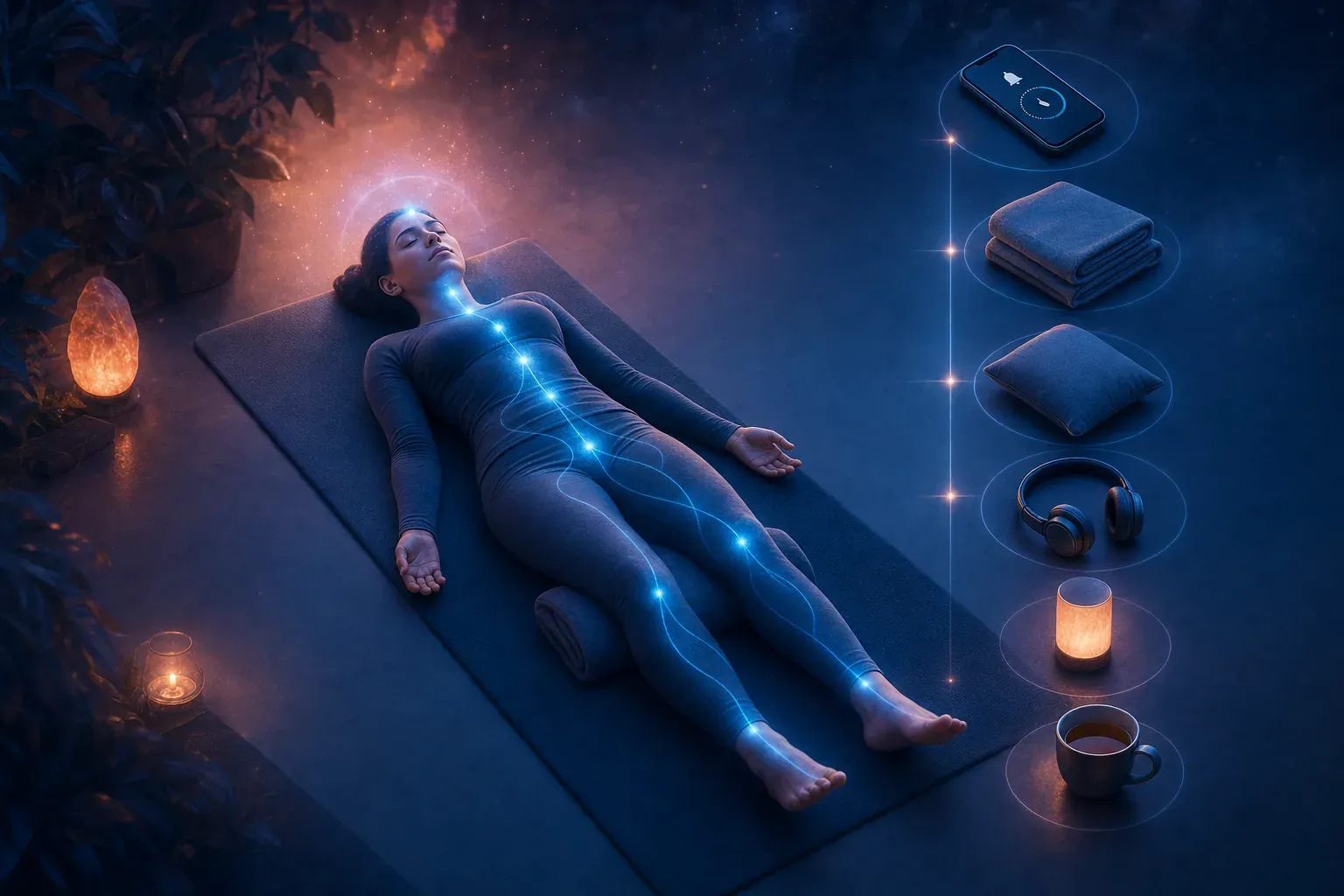
Don’t turn this 10-minute practice into a performance review.
You don’t need a cushion, a silent apartment, perfect posture, or the impossible instruction to “clear your mind.” A human brain produces thoughts the way Slack produces notifications: repeatedly and often at the least convenient time.
For your first body scan, consider one of these two setups:
- Lie down on a bed, couch, yoga mat, or carpet.
- Sit in a chair with both feet on the floor.
If you’re doing this during the workday, sitting is often better. If you lie down at 3:17 p.m. after six hours of meetings, your nervous system may interpret the body scan as a sleep opportunity.
Set a timer for 10 minutes if you’re using the main script. If 10 minutes feels too long, use the 5-minute version below. If even that feels ambitious, use the 3-minute desk scan.
A few useful permissions before the script starts:
- You can move if something hurts.
- You can open your eyes.
- You can skip any body area that feels too intense.
- You can stop the practice.
For people with trauma histories, chronic pain, panic symptoms, or body-related distress, a body scan can sometimes bring up more sensation than expected. Meditation-related adverse experiences have been documented in clinical literature, which is one reason choice and pacing matter (Britton et al., 2021). If this practice feels overwhelming, keep your eyes open, name five external objects in the room, feel your feet on the floor, or consider working with a qualified mental health professional who understands mindfulness and trauma.
A 10-minute body scan mindfulness script for beginners

Read this body scan mindfulness script slowly. If you’re guiding another person, leave pauses of 10 to 20 seconds in each body region. Many new guides rush because silence feels awkward, but silence is where the nervous system may have time to register sensation.
Think of this as a 10-minute body scan you can stretch to 20 minutes or compress to 5 minutes depending on the day.
Settling in
Find a position that feels steady enough for the next 10 minutes. If you’re lying down, let your legs rest naturally and place your arms by your sides or your hands on the belly. If you’re sitting, place both feet on the floor and let your hands rest on your thighs or in your lap.
You don’t have to look peaceful or feel calm. Let your eyes close if that feels comfortable. If not, soften your gaze toward one spot on the floor or wall. Take a slow breath in through the nose or mouth, then let it out.
Notice the places where your body touches something solid: the floor, chair, bed, cushion, or ground underneath you. Let the surface carry some of your weight for the next few minutes. You do not have to hold yourself together quite so tightly right now.
Feet and legs
Bring attention to the toes of the left foot. Notice warmth, coolness, tingling, pressure, fabric, or very little sensation. If you don’t feel much, simply notice “not much.” Move attention to the sole of the left foot, the arch, the heel, the top of the foot, and then the whole left foot.
Now bring attention to the toes of the right foot: the big toe, the smaller toes, and the spaces between them. You don’t need to wiggle them, though you can if that helps you locate sensation. Move to the sole of the right foot, the heel, the top of the foot, and the whole right foot.
Hold both feet in awareness together for a few breaths. Both feet resting. Both feet here. Let attention move to the ankles: left ankle, right ankle. Maybe there’s stiffness, ease, pressure from socks, or nothing obvious.
Move slowly into the calves, shins, and knees. Notice the back of the lower legs, the front of the lower legs, the front of the knees, the backs of the knees, and the inside of the knee joints. You’re not trying to picture anatomy perfectly; you’re feeling what can be felt.
If your mind has wandered into email, dinner, or a replay of a conversation from 2019, good catch. That moment of noticing is part of mindfulness practice. Bring attention back to the legs.
If there’s discomfort, see if you can name it as sensation: tight, pulsing, sharp, dull, warm, cold, spreading, or fixed. If it’s too much, shift your position. Mindfulness does not require gritting your teeth.
Hips, belly, and back
Move attention into the thighs: left thigh, right thigh, front of the thighs, backs of the thighs. Notice heaviness or lightness. Notice the points of contact underneath you where the chair, bed, or floor supports the upper legs.
Bring attention to the hips and pelvis. This is a place where many people hold tension without realizing it, especially after hours of sitting. You don’t need to release anything on command. Notice the weight of the pelvis, the front of the hips, the back of the hips, and the seat of the body.
Take one breath here. Let the exhale be easy. If the mind starts planning dinner, answering emails, or replaying a meeting, notice the thought and return to the hips or feet. That is the basic move: notice, return, begin again.
Bring attention to the lower belly. Notice movement as the breath comes and goes: rising, falling, expanding, softening. There’s no need to breathe in a special way. Let the body breathe.
Now notice the lower back. Maybe it’s touching the chair or floor. Maybe there’s an ache near the lumbar spine. Maybe there’s warmth, pressure, or no clear sensation. Try not to label the whole area as “bad” or “tight” too quickly. Get curious about details: Where exactly is the sensation? Does it have an edge? Does it stay the same, or change slightly as you observe it?
Stay with the lower back and belly for three breaths.
Chest, hands, and arms
Move attention up to the chest. Notice the front of the body: breastbone, ribs, collarbones, and the space around the heart. This area can feel emotionally loaded for some people. If that’s true for you, go gently. You can move attention back to the feet at any time.
Notice the movement of breathing in the chest and ribs. The breath may feel small or large, smooth or uneven. No need to improve it.
Bring attention to the upper back: shoulder blades, spine, and the muscles along either side. If you’ve spent the day at a laptop, this area may have strong opinions. Let the shoulders be exactly as they are for a moment before asking them to relax. Sometimes that is kinder.
Bring attention to the fingers of the left hand: thumb, index finger, middle finger, ring finger, little finger. Notice pulsing, tingling, temperature, contact, or blankness. Move into the palm of the left hand, the back of the hand, the wrist, the forearm, the elbow, the upper arm, and the shoulder. Sense the whole left arm from fingertips to shoulder.
Now move to the right hand: thumb, index finger, middle finger, ring finger, little finger, palm, back of the hand, wrist, forearm, elbow, upper arm, shoulder. Sense the whole right arm.
Now sense both arms together: both hands, both elbows, both shoulders. Let them rest for one breath.
Neck, jaw, face, and whole body
Bring attention to the neck: front of the throat, sides of the neck, and back of the neck. Notice whether you’re holding tension there. No need to force anything.
Move to the jaw. This one surprises people. Notice the hinge of the jaw, the teeth, the tongue, and the lips. If the teeth are clenched, let there be a little space between them. Let the tongue rest. Let the face be less arranged.
Bring attention to the cheeks, nose, eyes, forehead, space between the eyebrows, and scalp. Sense the whole head. Notice tiny movements, pressure, a busy feeling, or almost nothing. All of those can count as body awareness.
Now widen attention to include the whole body: feet, legs, hips, belly, chest, back, hands, arms, neck, face, and head. Sense the whole body breathing. Sense the whole body resting.
See if you can notice the body as one field of sensation. Some areas are loud. Some are quiet. Some are pleasant. Some are unpleasant. Some are neutral. Many sensations change.
Take a slow breath in. Let it out. Before you open your eyes, notice the room around you: sounds, temperature, light, and the surface underneath you.
When you’re ready, gently move the fingers and toes. If your eyes are closed, open them. Take your time. The practice is over, but you don’t have to rush back at full speed.
A 5-minute body scan script
Use this 5-minute body scan when you want the practice but don’t want a whole production.
Short script
Sit or lie down in a comfortable position. Let your eyes close, or keep them softly open. Take one slow breath in. Let it out.
Feel the contact between your body and the surface beneath you: chair, bed, floor, or couch.
Bring attention to your feet. Notice the toes, soles, heels, and tops of the feet. You don’t need to change anything.
Move attention to the lower legs: calves, shins, and knees. Notice temperature, pressure, muscle tension, or the absence of strong sensation.
Sense the thighs and hips. Let the lower body be heavy if it wants to be heavy.
Slowdive is a calm-tech companion — guided meditations, breathing practices, and sound therapy crafted for everyday balance.
Bring attention to the belly. Notice the movement of breathing: rising and falling.
Now notice the chest and back. Feel where the breath is easiest to detect. Notice where the body feels held, tight, open, or neutral.
Move to the hands: fingers, palms, wrists, arms, and shoulders. Let the shoulders drop by one percent, not because they should, but because they can.
Bring attention to the neck and jaw. Let the teeth separate. Let the tongue rest.
Notice the face: eyes, forehead, scalp. Let the muscles around the eyes soften.
Now sense the whole body at once: breathing, sitting or lying here, with nothing to solve for the next few breaths.
Take one more breath in. Let it out. Open your eyes, and return slowly.
A 3-minute body scan for your desk
This 3-minute body scan is the version for real life.
You’re not lighting a candle. You’re not changing pants. You’re not explaining to a coworker why you’re lying on the floor next to the printer.
You’re staying in your chair and coming back to the body you already brought to work.
Desk script
Place both feet on the floor. Let your hands rest somewhere easy. Lower your gaze, or close your eyes if that feels comfortable.
Notice your feet. Feel the floor underneath them. Press the toes down gently, then release.
Notice your legs against the chair. Notice the weight of your hips. Take one breath.
Feel the belly or chest move as you breathe. Notice your back. If you can, let the chair support you a little more.
Notice your shoulders. Lift them slightly toward your ears, then let them drop.
Notice your hands. Uncurl the fingers. Soften the palms.
Notice your jaw. Let the teeth separate. Notice your face. Let the forehead smooth a little.
Feel the whole body sitting here: feet on the floor, breath moving, hands resting.
For one more breath, do nothing. Then look around the room and continue your day.
How to use this body scan mindfulness script when your mind wanders
Your mind will probably wander during a body scan. Most people’s minds do. Mind-wandering is not a defect in the practice; it is part of the training material.
Mayo Clinic’s patient guidance describes meditation as focusing attention and reducing the stream of crowded thoughts that can contribute to stress. That does not mean the stream disappears on command, especially during a first 10-minute body scan.
The return often matters more than the staying.
If you notice you’ve been thinking about an email for the past 90 seconds, you haven’t failed. You woke up inside the practice.
Use a simple label: “thinking.” Then return to the body area you last remember.
If you don’t remember where you were, return to the feet. The feet can be reliable anchors because they have contact, pressure, temperature, and gravity to work with.
What if I feel nothing?
Feeling nothing is common, especially early in body scan practice.
Some body areas are easy to feel. Hands, face, belly, and feet often give you something to work with because they have rich sensory input. Other areas may feel vague, like trying to tune a radio station from two towns over.
Don’t strain.
If you feel nothing in your left shin, notice that. “Blank” is an experience. “Numb” is an experience. “I don’t know” is an experience.
You can also make sensation easier to find:
- Press your feet gently into the floor.
- Rub your palms together once, then rest them.
- Take a slightly deeper breath and feel where the ribs, belly, or back move.
Then go back to observing.
The point isn’t to create fireworks in your kneecaps. The point is to build a steadier relationship with what’s already happening. That’s why a body awareness meditation can be ordinary and still useful.
What if the body scan makes me sleepy?
If the body scan makes you sleepy, your body may be tired.
That sounds obvious, but many people turn exhaustion into a character flaw. If you fall asleep during a body scan at night, it may simply become part of your sleep routine. If you fall asleep every time and want to stay awake, sit in a chair, keep your eyes slightly open, or practice before 3 p.m.
Sleepiness can also be useful information. Maybe the only quiet moment in your day is the 10 minutes when nobody is asking you for anything. Of course your system powers down. It’s been waiting.
If your goal is mindfulness rather than sleep, keep the posture upright and alert. If your goal is to unwind before bed, let sleep happen.
What if I notice pain or discomfort?
Start with practical adjustments, not spiritual heroics.
Change your posture. Put a pillow under your knees. Sit instead of lying down. Move your shoulder. You’re allowed to take care of the body you’re paying attention to.
If the discomfort is mild enough to observe, get specific. Instead of “my back hurts,” try one of these labels:
- “Warmth in the lower right back.”
- “Pulling near the left shoulder blade.”
- “Pressure behind the right knee.”
- “Sharp sensation near the hip joint.”
This kind of precise attention may help reduce the extra layer some people add to discomfort: the story, the dread, the argument with reality.
Be careful here. You are not trying to out-meditate pain. You’re learning to notice sensation without immediately tightening around it. That’s different.
Should you scan from head to toe or toe to head?
Either direction can work.
Feet to head can be beginner-friendly because the feet may feel less emotionally charged for many people. Starting at the feet also gives attention a clear grounding cue: pressure against the floor, temperature in the toes, contact with socks or shoes.
If you prefer head to toe, use that. For a body scan before sleep, head to toe can feel like slowly turning down the lights: forehead, jaw, shoulders, chest, belly, legs, feet.
The order usually matters less than the attitude: slow, curious, and unforced.
How often should beginners practice?
Start with 5 minutes, three times a week.
That may be enough repetition to learn the route through the body, and it’s small enough that you won’t need to redesign your personality around meditation.
After two weeks, notice what you actually did, not what your fantasy self planned to do. If you practiced once a week, make that the baseline. If 10 minutes felt useful, keep going. If 10 minutes felt like being trapped in an elevator with your own thoughts, use the 3-minute desk version.
Consistency can help, but consistency doesn’t have to mean daily perfection.
A practical rhythm:
- Monday morning before opening email.
- Wednesday after lunch.
- Friday at the end of the workday.
That’s it. Put the 5-minute body scan in your calendar if you need to, as a small appointment with your nervous system.
Your first body scan can be ordinary
Please don’t wait until the perfect evening.
Do it badly today. Do it in work clothes. Do it with traffic outside. Do it while your dishwasher runs. Do it for three minutes and get bored. Do it and discover that your left foot is strangely fascinating for half a second.
That counts.
A body scan mindfulness script is a beginner practice in the best sense: simple enough to start, deep enough to keep teaching you. You’re not trying to escape your life. You’re practicing how to come back to the one body that has been carrying you through it.
If you want a guided body scan meditation with pacing built in, save this body scan mindfulness script for later. And when you’re ready to find a practice that fits your day, Find your meditation match.
This article is for general information and isn't medical advice. If you have ongoing concerns, consult a healthcare professional.
Curious about where to begin? A short check-in maps your stress baseline and suggests a personalised practice plan.