
Meditation techniques for anxiety beginners can try


Meditation can sound ridiculous when anxiety is loud. Sit still? Close your eyes? Watch your breath while your brain runs a legal investigation into every possible future disaster?
A few simple meditation techniques for anxiety may still help. Not as a cure. Not as a personality transplant. More like a handrail when your attention has sprinted three blocks ahead of your body.
The goal is not to stop thinking. It is to notice the anxious loop, return to one sensory anchor, and repeat that return without turning a 3-minute practice into a referendum on your character.
The NIH NCCIH describes meditation and mindfulness as practices that may support stress reduction. A 2010 meta-analysis in the Journal of Consulting and Clinical Psychology found that mindfulness-based approaches were associated with improvements in anxiety and mood symptoms across clinical samples (Hofmann et al., 2010).
Meditation is a practice. For some people, it may support anxiety care alongside sleep, therapy, medication, movement, and fewer 11 p.m. inbox checks. It will not make you immune to hard mornings.
Find your meditation match in 60 seconds Use the techniques below like a small menu for real anxious moments: 60 seconds at your desk, 3 minutes before a presentation, or 5 minutes when your shoulders have been parked near your ears since lunch.
Start with the 60-second breath anchor

The 60-second breath anchor is the technique I’d often suggest for someone who says, “I can’t meditate. My brain never shuts up.”
A wandering brain is not necessarily a failed meditation session; in a 60-second practice, noticing the wandering is part of the repetition.
Set a timer for 60 seconds. Sit in a chair with both feet on the floor. Let your hands rest somewhere boring, like your thighs or the desk. You don’t need a candle, perfect posture, or anything beyond one minute.
Choose one spot where you can feel breathing: air at your nostrils, chest lifting, belly expanding, or shoulders softening on the exhale.
Pick one anchor. Stay with that nostril, chest, belly, or shoulder sensation.
When your mind leaves, and it probably will, silently say “thinking” and come back to the breath. If it leaves 25 times, return 25 times. That is the session.
For anxious beginners, this breathing meditation for anxiety may help because it gives the mind one clear job: feel the next breath instead of litigating the next email.
One minute can count because the nervous system often learns through repetitions, not through dramatic spiritual performances.
Use box breathing when you need structure
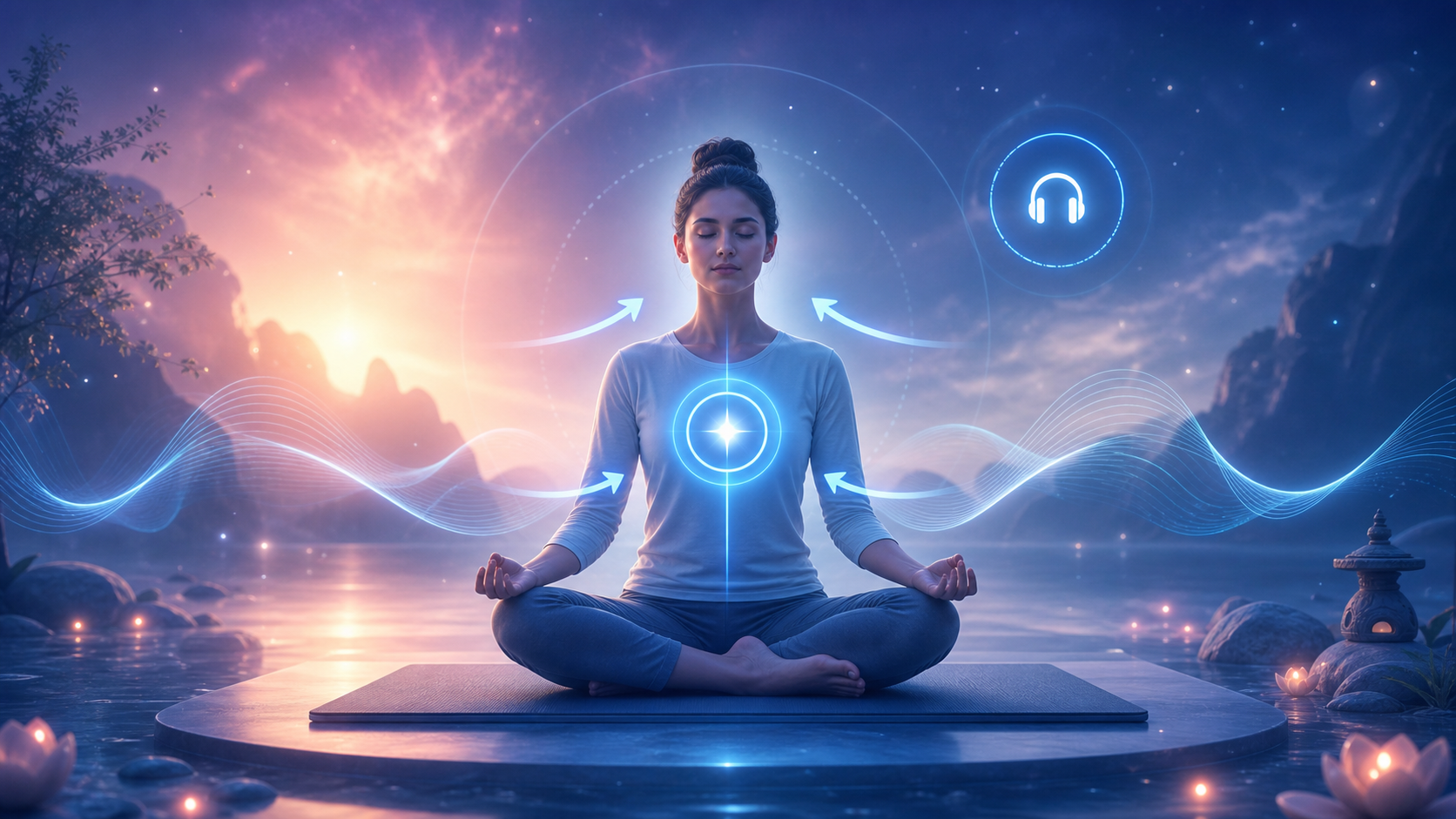
Box breathing may be useful when anxiety feels shapeless because the 4-4-4-4 pattern gives attention a predictable route to follow.
Here’s the basic version:
- Inhale for 4 counts.
- Hold for 4 counts.
- Exhale for 4 counts.
- Hold for 4 counts.
Repeat for 4 rounds.
If holding your breath makes you feel worse, skip the holds. Some anxious bodies are sensitive to breath retention or carbon-dioxide buildup. There’s no medal for forcing it. Try inhaling for 4 and exhaling for 4 instead.
Box breathing can be practical before a meeting, presentation, interview, or difficult conversation because counting may occupy just enough working memory to interrupt rehearsal loops.
Slow breathing practices have been linked with changes in autonomic and emotional regulation, according to a review by Zaccaro and colleagues in Frontiers in Human Neuroscience (Zaccaro et al., 2018). That doesn’t mean one round will erase anxiety. It means the breath may be a practical lever for shifting arousal for some people.
Use box breathing gently. If you get dizzy, stop and breathe normally. Skip breath-hold practices if you have a respiratory or cardiac condition, unless a qualified clinician has told you they are appropriate for you.
For a shorter reset, try these breathing exercises for calm.
Try the longer-exhale breath for racing thoughts
The longer-exhale breath is a useful “I need to come down one notch” practice for many people because it changes the rhythm without asking you to sit still for 20 minutes.
It’s simple:
Inhale for 4. Exhale for 6.
Do that for 2 minutes.
Don’t gulp air or perform calm. Keep the inhale easy and let the exhale feel like slowly fogging a mirror, with your mouth closed if nasal breathing feels comfortable.
If 4 and 6 feel awkward, try 3 and 5. If counting annoys you, use words:
Inhale: “I’m here.” Exhale: “This moment.”
Yes, the phrase can feel cheesy. Anxiety can be cheesy too: it repeats the same catastrophic plot with little character development. You’re allowed to answer the amygdala’s disaster script with one plain sentence.
Do a body scan when anxiety lives in your shoulders
Anxiety often shows up before we name it: teeth clenched, breath shallow, stomach tight, shoulders hovering near the ears like they’re trying to leave the building.
A body scan may help train interoception, the ability to notice internal sensations, without immediately arguing with them or turning every heartbeat into a diagnosis.
Try this for 5 minutes. Sit or lie down. Close your eyes if that feels okay. If not, soften your gaze at the floor.
Move attention slowly through the body:
Feet. Calves. Thighs. Hips. Belly. Chest. Hands. Arms. Shoulders. Neck. Face.
At each location, ask one quiet question: “What’s here?”
You might notice warmth, pressure, tingling, numbness, tightness, pulsing, or nothing obvious. All of those count. You’re not trying to relax each body part on command. You’re practicing contact.
If you hit a spot that feels intense, widen your attention. Feel your feet and the chair at the same time. Open your eyes. Look around the room. A body scan should not feel like being trapped inside your ribcage.
Practice “noting” when overthinking takes over
Noting is a mindfulness meditation for anxiety where you label the mind’s activity in one or two words.
You’re not analyzing the thought. You’re tagging the mental event so it has less room to pose as the entire truth.
Examples:
“Planning.” “Worrying.” “Rehearsing.” “Judging.” “Remembering.” “Catastrophizing.”
Sit for 3 minutes. Feel the breath. When a thought pulls you away, name the category softly in your mind, then return to the breath or body.
Thought: “What if I freeze during the presentation?” Label: “Worrying.” Return: breath at the nostrils.
Thought: “This meditation is pointless.” Label: “Judging.” Return: hands resting.
The useful shift is the tiny gap between you and the thought. Anxiety says, “This is urgent and true.” Noting says, “This is worry.”
That gap may last half a second. For a beginner, half a second can still be meaningful. If you want the slower version, here’s how to practice mindfulness meditation.
Use 5-senses grounding when anxiety feels too big for closed eyes
Some anxious moments are not ideal for classic eyes-closed meditation. During a panic spike, closing your eyes can amplify heartbeat, dizziness, or breath sensations.
Use the 5-senses practice instead.
Name:
5 things you can see. 4 things you can feel. 3 things you can hear. 2 things you can smell. 1 thing you can taste.
Do it slowly. Be literal.
“I see the blue mug.” “I feel my socks.” “I hear traffic.” “I smell coffee.” “I taste toothpaste.”
This is meditation in street clothes. You’re training attention to return to the present through sensory data instead of anxious prediction.
It can work well in public because nobody knows you’re doing it. You can use it on the subway, in a waiting room, outside a conference room, or while standing in a bathroom stall pretending to check your phone.
If you are having symptoms that feel medically urgent, such as chest pain, fainting, or trouble breathing that doesn’t settle, seek urgent medical help. Meditation is not the move for every body sensation.
Try walking meditation if sitting makes you restless
Many beginners assume meditation means sitting still on a cushion. That is one door, not the whole building.
Walking meditation may be useful when anxiety comes with restless energy. Find a hallway, sidewalk, or quiet stretch of floor. Walk just slow enough to feel each step.
Pay attention to four parts of the movement:
Lift. Move. Place. Shift.
When the mind runs off, come back to the sole of the foot meeting the ground.
You can do this for 3 minutes, from your desk to the kitchen, or around the block before a hard call. If this is your doorway, try walking meditation for a little more structure.
Slowdive is a calm-tech companion — guided meditations, breathing practices, and sound therapy crafted for everyday balance.
Walking meditation can remind the anxious brain that the body is on this sidewalk, not in next Thursday’s imagined disaster.
Use progressive muscle relaxation when you’re clenched
Progressive muscle relaxation is not always described as meditation, but it may belong in the anxiety beginner’s toolkit because it teaches the contrast between contraction and release.
The practice is straightforward: tense a muscle group for a few seconds, then release it. You move through the body and notice the difference between tight and soft.
Try this:
Curl your toes for 5 seconds. Release. Tense your calves for 5 seconds. Release. Squeeze your thighs. Release. Tighten your hands into fists. Release. Lift your shoulders toward your ears. Release. Scrunch your face. Release.
Keep breathing. Don’t tense so hard that it hurts.
This practice can be especially useful for people who say, “I didn’t realize how tense I was until 6 p.m.” It may build recognition. The earlier you notice the jaw, fist, or shoulder clench, the easier it may be to soften your grip before the workday takes all of you.
Try loving-kindness when anxiety turns mean
Anxiety is not only fear. Sometimes it is fear wearing a critic’s jacket.
“You’re behind.” “You’re bad at this.” “Everyone can tell.” “You always mess this up.”
Loving-kindness meditation can feel unnatural at first, especially if your inner voice is more courtroom prosecutor than supportive friend. Keep the phrases plain and concrete.
Place a hand on your chest or lap. Say silently:
“May I be safe.” “May I be steady.” “May I meet this moment with care.”
If that feels too soft, try:
“This is hard.” “I can take one breath.” “I don’t have to solve everything right now.”
This does not require becoming a person who whispers affirmations into herbal tea. It means the tone you use with yourself may matter. An anxious mind already feels threatened. Adding contempt can give the threat system more evidence.
Use guided meditation when silence is too much
Silent meditation is not the beginner setting for everyone.
If your mind gets louder the second the room goes quiet, use a guide. A calm voice gives you a sequence to follow: feet, breath, shoulders, pause. It also removes the question, “Am I doing this right?” because someone else is holding the map.
Look for guided meditation for anxiety between 5 and 10 minutes. Longer sessions can be useful later, but anxious beginners often need repeatable wins.
A good guided session should:
- Start quickly, without a long lecture
- Offer clear breath or body cues
- Leave space instead of filling every second with talking
- Avoid promising that you’ll feel peaceful by the end
That last point matters. Some sessions end with calm. Some end with, “Well, I noticed that I’m anxious.” That is still practice.
If you’re using a guided session at work, keep headphones nearby and choose one in advance. Anxiety loves friction. Don’t make yourself search for the perfect 9-minute track while your heart is already racing.
Build a tiny practice you’ll actually repeat
The classic beginner mistake is going too big.
Someone has one stressful week, downloads an app, declares they will meditate 30 minutes every morning, misses day three, and decides they are spiritually defective.
Don’t build a monastery schedule for a Tuesday lunch break.
Start with 3 minutes a day for 7 days. Use the same time if possible: after coffee, before lunch, or right after shutting your laptop. Attach the practice to something that already exists.
Here’s a simple first week of beginner meditation for stress:
Day 1: 60-second breath anchor, repeated twice Day 2: 3-minute longer-exhale breath Day 3: 5-senses grounding Day 4: 3-minute body scan Day 5: box breathing for 4 rounds Day 6: walking meditation around the block Day 7: guided meditation for anxiety
At the end of each session, write one sentence: “Before practice I felt , after practice I feel .”
Do not grade yourself on calm. Grade yourself on showing up for the 3-minute repetition.
That one-sentence log can also show you which meditation techniques for anxiety seem to fit your nervous system. Some people love breathwork. Others feel better with walking, grounding, or body scans. The point is to build a menu for real days, not a perfect identity as a meditator.
What to do when meditation makes anxiety louder
Meditation can make anxiety louder for some people, especially when the technique increases internal focus.
You sit down, close your eyes, and suddenly your heartbeat is the loudest sound in the room. Or a memory surfaces. Or your thoughts speed up because there’s no podcast, email, or task to cover them.
First, open your eyes.
Then orient to the room. Name where you are. Feel your feet. Look for straight lines: the doorframe, the edge of the desk, the window. Let the eyes move.
Switch from internal focus to external focus. Use 5-senses grounding or walking meditation instead of breath awareness. Shorten the session to 30 seconds if needed.
Meditation should be adjustable. If a technique makes you feel trapped, it may be the wrong technique for that moment.
A 2021 paper in Clinical Psychological Science described meditation-related adverse events for some practitioners, which is one reason gentleness matters (Britton et al., 2021). For people with trauma histories, panic disorder, or intense body-based anxiety, guided support can be worth considering. Talk with a qualified healthcare professional if meditation repeatedly worsens symptoms or brings up experiences that feel unmanageable.
There is no purity test here. Safe practice beats heroic practice.
A 3-minute anxiety meditation you can try now
If you want to practice before you overthink the practice, use this 3-minute sequence.
Sit down. Let both feet touch the floor.
For the first minute, notice contact. Feet on floor. Body on chair. Hands resting. Say silently, “Here.”
For the second minute, breathe in for 4 and out for 6. If counting feels tight, let the exhale be just a little longer than the inhale.
For the third minute, label thoughts gently. “Planning.” “Worrying.” “Judging.” Each time, return to the feeling of your feet.
When the timer ends, don’t jump up immediately. Look around. Notice one color in the room. Move your shoulders. Then continue your day.
No fireworks required. A 3-minute practice can still be a nervous-system repetition.
The quiet skill underneath every technique
All these meditation techniques for anxiety train one skill: coming back.
Back to the breath. Back to the body. Back to the floor. Back to the sound of the room. Back to the next step.
Anxiety pulls attention into threat, prediction, and rehearsal. Meditation can give attention a steadier landing place: one exhale, one footstep, one blue mug, one label.
That landing may last half a second. Fine. Land again.
If you’re a beginner, don’t chase the perfect method. Choose one technique from this list and practice it for a week. Keep it small enough that you can do it on a normal Tuesday, not just during an imaginary future life with better lighting and fewer emails.
If you want a place to start, open Slowdive and use the short guided anxiety sessions in the app’s meditation library. Pick a 5-minute practice, put it right before the part of your day that usually spikes, and when you’re ready to find a practice that fits your day, Find your meditation match.
FAQ
What are the best meditation techniques for anxiety beginners?
Useful starting points are often short and concrete: a 60-second breath anchor, 4-to-6 longer-exhale breathing, 5-senses grounding, a 5-minute body scan, or guided meditation. Choose the one that feels least intimidating. You are not trying to win meditation. You are practicing the return.
How often should I meditate for anxiety?
Start with 3 minutes a day for 7 days. That may be enough to learn what your nervous system responds to without turning meditation into another task you can fail. If daily practice feels unrealistic, try it before predictable stress points, like email, meetings, or bedtime.
Can meditation make anxiety worse?
Yes, sometimes. Closed eyes, silence, or intense body focus can make anxiety louder for some people. If that happens, open your eyes, look around the room, feel your feet, and switch to 5-senses grounding or walking meditation. Meditation should be adjustable, not something you force through.
Why does breathing meditation help with anxiety?
Breathing gives attention a simple sensory anchor. Counting breaths or lengthening the exhale may also interrupt the mental loop of predicting and rehearsing. It may not remove anxiety completely, but it can help some people feel the body come down one notch.
Should I use guided meditation for anxiety or sit in silence?
Use guided meditation if silence feels too big. A 5- to 10-minute voice-led practice gives structure, cues, and pacing, which may help beginners. Silent practice can come later if you want it. The better technique is usually the one you will actually repeat.
This article is for general information and isn't medical advice. If you have ongoing concerns, consult a healthcare professional.
Curious about where to begin? A short check-in maps your stress baseline and suggests a personalised practice plan.