
UCLA mindfulness meditation: beginner lessons


UCLA mindfulness meditation is a beginner-friendly way to practice noticing breath, body sensations, sounds, and thoughts, then gently returning attention without treating distraction as failure.
That was the assignment: not bliss, not a personality transplant, not becoming unbothered before a quarterly planning call. Just breath, wandering, noticing, returning.

That sequence is the beginner core of UCLA mindfulness meditation. UCLA Mindful, the mindfulness education center at UCLA Health, offers guided practices led by teachers including Diana Winston, with short meditations available in its guided meditation library (UCLA Health). For a beginner, the value is practical: the audio gives you a beginning bell, a voice, an anchor, and an ending point, so you don’t have to design a meditation practice from scratch at 7:42 a.m.
Structure can matter when your attention is already sprinting through email, traffic, and calendar alerts.
Find your meditation match in 60 seconds
What UCLA mindfulness meditation actually teaches

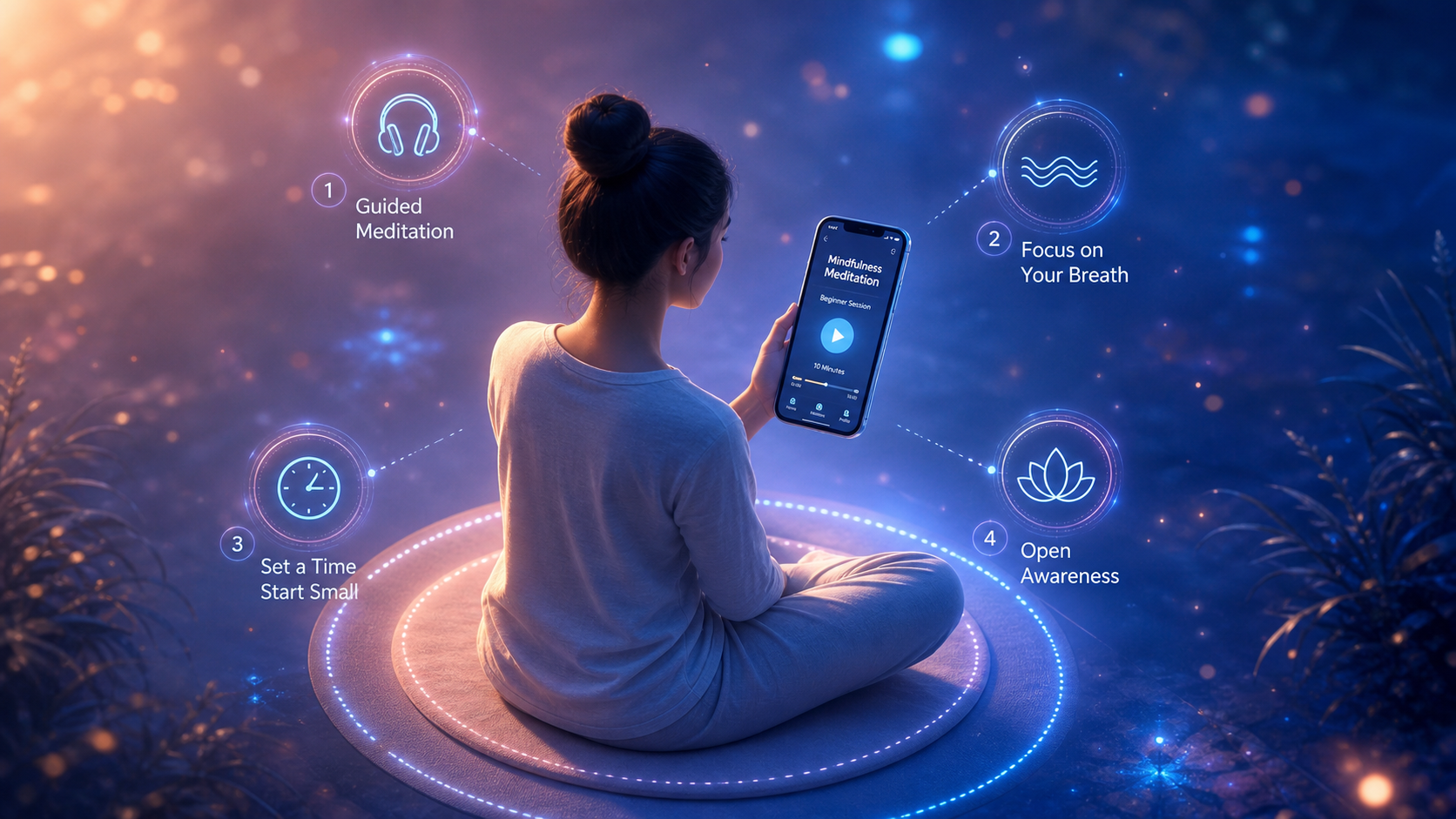
The beginner lesson inside most UCLA mindfulness meditation practices is deliberately plain: pay attention to present-moment experience with less judgment than your nervous system usually adds.
That sounds almost too simple until you test it with a real mind on a real Tuesday.
You sit down, feel one breath, and three seconds later you’re replaying a Slack message or decoding the tone in your manager’s voice. Then you notice the drift. In mindfulness training, that noticing is not necessarily the error; in many beginner practices, it is the repetition.
Diana Winston, who has served as Director of Mindfulness Education at UCLA’s Mindful Awareness Research Center, defines mindfulness as attention to present-moment experience with openness and curiosity (Diana Winston). The UCLA mindfulness meditation style is secular and practice-based: it does not ask you to adopt a belief system before you can follow a five-minute breathing meditation.
The NIH National Center for Complementary and Integrative Health describes meditation and mindfulness as practices that may help with stress and anxiety, while noting that evidence differs by condition, population, and meditation approach (NIH NCCIH). That cautious framing is useful for beginners: meditation is a trainable attention skill, not a guaranteed mood switch.
One UCLA mindfulness meditation session may not change your day, and that does not mean you failed.
Five minutes may still give you one cleaner breath before a difficult conversation, which is a modest but meaningful enough start for week one.
Start with the shortest UCLA mindfulness meditation you’ll actually repeat
Beginners often pick a 30-minute meditation because “proper meditation” sounds like it should require discipline, silence, and a heroic amount of time.
Then they do that 30-minute session once.
Start with the shorter track. UCLA’s guided meditation library includes brief breathing, body awareness, and loving-kindness practices (UCLA Health). If you’re new to mindfulness meditation for beginners, choose a 3-to-10-minute practice. The training target is not endurance; it is recognition: breath, thought, return.
A five-minute UCLA mindfulness meditation repeated four mornings in one week is likely to build more practical familiarity than one 45-minute sit followed by guilt.
Try this 7-day setup:
- Pick one UCLA guided meditation.
- Use the same audio for seven days.
- Stop grading the session by how calm you feel.
That third step is the trapdoor. Calm is pleasant, but calm is not the assignment. Some mornings your shoulders may drop after the first minute; other mornings you may feel bored, itchy, or annoyed by the teacher’s pacing. Those reactions are not interruptions to the practice; they are the mind-state data you are learning to observe.
If you want a wider primer before pressing play, this guide to how to practice mindfulness meditation can sit beside your UCLA mindfulness meditation routine.
One breath is not a slogan in this context; it is the smallest repeatable unit of attention training.
The first lesson: your mind will wander
If your mind wanders during UCLA mindfulness meditation, you have received confirmation that your brain is functioning like a human brain.
A 2010 experience-sampling study in Science by Matthew Killingsworth and Daniel Gilbert found that participants’ minds wandered 46.9% of the time across everyday activities (Killingsworth and Gilbert, 2010). That finding does not make mind-wandering “bad” in every context, but it does puncture the beginner myth that planning dinner halfway through an inhale means you are uniquely terrible at meditation.
The basic rep has three parts: notice the thought, return to the breath or body anchor, and repeat the same move when the next thought arrives.
Guided mindfulness meditation can help because the teacher’s voice interrupts the spiral. When you hear “when the mind wanders, gently bring it back,” the audio reminds your nervous system that wandering was expected. The return is the repetition.
Think of it like lifting a very small weight: unimpressive from the outside, meaningful from the inside.
If you’re using a UCLA mindfulness meditation practice focused on breathing, do not chase a special breath. Feel the ordinary breath you already have. Choose the clearest location: nostrils, chest, belly, or the whole torso.
The word “lightly” matters because anxious professionals often turn breath practice into a performance review: Was I focused enough? Did I do the body scan correctly? Why am I still tense at minute four?
Use a smaller label instead: “thinking.” Not “I’m failing,” not “I’m too anxious for UCLA mindfulness meditation,” just “thinking,” followed by a return to the next breath.
The second lesson: posture matters less than honesty
Some people picture meditation as a cushion, a straight spine, and a room quiet enough for a monastery bell.
A cushion is useful if you own one. It is not required if your actual practice location is an office chair, a parked Honda, or the edge of a bed.
For UCLA mindfulness meditation guided practices, choose a posture that supports two conditions: you can breathe naturally, and you can stay awake. If you’re sitting, place both feet on the floor, let your hands rest, and soften the jaw. You do not need to look serene.
Looking serene can become its own distraction, especially if part of your mind is checking whether you appear like a person who meditates.
A beginner posture only needs to answer two questions: Can I breathe here, and can I remain alert for the length of this 5-minute audio?
If yes, begin the UCLA guided meditation.
In an office, use a two-minute setup before pressing play. Turn your chair slightly away from the monitor. Start the audio, put the phone face down, and let your shoulders drop once, not dramatically, just enough to signal that typing has paused.
That is where UCLA mindfulness meditation can become usable outside a retreat setting. You need a repeatable doorway, not a perfect room.
The doorway might be a parked car in Seattle, the last stall in a quiet restroom, or the left side of the bed before the day starts making claims on your attention.
The third lesson: body scans are underrated for beginners
If breath meditation makes you more anxious, try a body scan instead of forcing another breath-focused session.
That reaction is common enough to plan for. Some beginners focus on the breath and quickly feel trapped in the chest or overly alert to heartbeat and air hunger. A body scan gives attention more territory: feet, legs, belly, hands, shoulders, jaw, eyes.
UCLA’s guided meditation library includes body-based practices, which can be a gentler entry point for people who find breath focus too intense (UCLA Health). For many beginners, a body scan may be the first UCLA mindfulness meditation format that feels doable rather than claustrophobic.
Use this beginner sequence: start with the feet, notice contact with the floor, move to the legs, and name basic sensations such as pressure, warmth, tingling, numbness, or nothing obvious.
“Numbness” and “nothing obvious” count. You are not trying to manufacture sensation in the left ankle; you are learning to notice what the body is already reporting.
A body scan can also reveal hidden effort: the tongue pressed to the roof of the mouth, fingers curled slightly, belly held in, shoulders lifted toward the ears as if a deadline lives in the collarbones.
You do not have to force those places to relax. In a UCLA mindfulness meditation body scan, noticing tension can be useful information.
Sometimes noticing softens the jaw or hands. Sometimes it does not. Both outcomes belong in the practice.
The fourth lesson: sound can be an anchor
Sound practice can teach beginners to stop treating noise as a meditation failure.
Traffic outside the window, a refrigerator hum, a dog barking in the hallway, or a neighbor dropping something heavy at exactly the wrong moment can become part of the field of awareness.
A sound-based mindfulness practice asks you to hear before the story begins. Not “who is making that noise?” or “why is my apartment like this?”, just the raw contact of hearing.
This is especially useful because modern life is not quiet. Waiting for perfect silence can become a sophisticated form of procrastination. If you live with roommates, children, thin walls, sirens, or construction across the street, sound practice may be the most realistic doorway into UCLA mindfulness meditation.
Try this 60-second preparation before a UCLA guided meditation: close your eyes if that feels safe, notice the farthest sound, notice the closest sound, and then notice the next sound for half a second before naming it.
That half second is the gap between sensory contact and commentary. Meditation can train attention inside that gap.
The fifth lesson: you can be skeptical and still practice
Skeptical meditators often make good beginners because they do not want incense smoke covering the fine print. They want to know what UCLA mindfulness meditation may train and what it cannot promise.
UCLA mindfulness meditation may fit that temperament because the public practices are plainspoken and secular in tone.
The science is still developing. David Creswell’s 2017 review in Annual Review of Psychology described mindfulness interventions as a promising but methodologically uneven research area, with a need for stronger trials and clearer definitions (Creswell, 2017). That is the middle path for beginners: don’t dismiss mindfulness because the instructions sound simple, and don’t crown it as a cure.
Use UCLA mindfulness meditation as attention training, closer to stretching than to a miracle treatment.
Run a two-week experiment. Choose one UCLA meditation, practice at the same time each day, ideally before your phone absorbs the morning, and write one sentence afterward: “Right now, I notice…”
At the end of 14 days, do not ask, “Am I transformed?” Ask narrower questions: Do I notice jaw tension sooner? Do I pause before reacting in email? Do I recover from small stressors a little faster?
Those are more honest measures, and they better match the scale of a beginner practice.
Slowdive is a calm-tech companion — guided meditations, breathing practices, and sound therapy crafted for everyday balance.
How to use the UCLA mindfulness app without turning it into another task
UCLA Mindful also has a mobile app, described by UCLA as a way to practice mindfulness meditation anywhere with guidance from UCLA Mindful (UCLA Mindful on the App Store, UCLA Mindful on Google Play). The UCLA mindfulness app can reduce friction by putting guided audio on the same device you already carry. The risk is also obvious: the phone is where notifications, shopping carts, and news alerts live.
Set one rule before you open the app: no browsing during practice time.
Pick the practice before the stressful moment arrives. If you decide at 11:30 p.m., tired and overstimulated, you may sample six tracks, read descriptions, check one notification, and somehow end up comparing lamps.
Choose a default menu in advance: a 5-minute breathing practice for morning, a 3-minute body awareness practice for lunch, or a body scan for evening.
One default is enough. Options are useful only if they reduce friction rather than create a new decision tree.
The app can make UCLA mindfulness meditation easier to start, but it cannot choose your intention for you.
If you’re practicing before sleep, be precise about the goal. Meditation may help some people wind down, but using it as a nightly test can backfire. The thought “this better make me sleep” is not relaxing. If sleep is the concern, treat meditation as a way to notice the body in bed, not as a lever you pull to force unconsciousness. If you’re comparing bedtime tools, this list of free sleep meditation apps can help.
A 2015 randomized clinical trial in JAMA Internal Medicine found that a mindfulness awareness practices program improved sleep quality in older adults with moderate sleep disturbance compared with a sleep hygiene education program (Black et al., 2015). That result is encouraging, but it does not mean every individual UCLA mindfulness meditation session will make sleep arrive on command.
Pressure is a poor lullaby, especially at 2:13 a.m.
What to do when UCLA mindfulness meditation feels uncomfortable
Beginner meditation advice often skips distress, which is a mistake.
Sitting quietly can make anxiety, grief, anger, body sensations, or intrusive thoughts more noticeable because the usual distractions have been turned down. That does not automatically mean UCLA mindfulness meditation is wrong for you, but it does mean dosage matters.
Some meditators report difficult or distressing experiences during practice, including fear, emotional intensity, and changes in perception; Britton and colleagues examined meditation-related adverse effects in Clinical Psychological Science in 2021 (Britton et al., 2021). This is one reason short, guided beginner practices may be preferable to white-knuckling through a long silent sit, especially if you are new to meditation or have a history of anxiety, panic, trauma, or dissociation.
If a UCLA mindfulness meditation practice feels overwhelming, open your eyes, look around the room, name five ordinary objects, feel both feet, and stop the audio if you need to.
You do not earn extra points for pushing through distress. If you have a trauma history, panic symptoms, dissociation, or meditation consistently makes you feel worse, consider working with a qualified clinician or meditation teacher who understands trauma-sensitive practice.
For everyday discomfort, use one distinction: restlessness may be workable, while overwhelm is a signal to slow down.
Restlessness sounds like, “I don’t like being still.” Overwhelm sounds like, “This is too much for my system right now.”
Respecting that difference is part of responsible UCLA mindfulness meditation practice.
A simple 7-day UCLA mindfulness meditation plan
Use this plan as a beginner protocol, not a personality renovation project.
Day 1: One breath practice
Choose a short UCLA mindfulness meditation breathing practice. Sit in a chair, keep both feet on the floor, and make the goal embarrassingly small: hear the whole audio from the first instruction to the final bell.
Day 2: Same practice, same place
Repeat yesterday’s UCLA meditation in the same location. Familiarity is the lesson. Notice whether the mind wants novelty instead of practice.
Day 3: Add one sentence afterward
After meditating, write: “Right now, I notice…” Finish the sentence without making it poetic.
Example: “Right now, I notice my shoulders are still tight.”
That sentence counts because it names present-moment data instead of chasing a special meditation feeling.
Day 4: Try a body scan
If the breath has felt tight or annoying, switch to a UCLA body scan. Let the teacher guide attention from region to region, and do not hunt for relaxation.
Day 5: Practice with sound
Before the guided meditation, spend 60 seconds listening. Let nearby sounds come and go, then begin the UCLA audio.
Day 6: Use it before a real moment
Meditate before something mildly stressful: a meeting, a commute, or a family call. Do not expect UCLA mindfulness meditation to remove stress. See whether it gives you half a beat before you enter the situation.
Half a beat can be useful because many regrettable emails and sharp replies happen quickly.
Day 7: Repeat your favorite
Choose the UCLA mindfulness meditation you will actually do again, not the one that sounds most impressive.
At the end of the week, choose a default practice for the next seven days. Beginners do not need a giant meditation library; they need a groove.
Common beginner problems, and the kinder fix
“I can’t stop thinking.” You probably won’t, at least not on command. UCLA mindfulness meditation trains the recognition of thought and the return to an anchor, not the deletion of thought.
“I get bored.” Of course. A nervous system used to tabs, texts, and streaming audio may register stillness as under-stimulation. Boredom is not necessarily a wall; it is a texture to notice.
“I don’t feel calm.” Calm can happen, but awareness comes first. Sometimes awareness notices that you are not calm at all.
“I keep forgetting to practice.” Attach the UCLA meditation to something already stable: after brushing your teeth, before opening email, or after parking the car. A practice without an anchor can become a nice idea, and nice ideas are fragile.
“I fall asleep.” Sit up, practice earlier, or use a shorter meditation. If your body is exhausted, sleep may be the more honest need.
This is where UCLA’s beginner-friendly approach may help. The practices are clean and direct; they do not bury you in theory before you have a direct experience of breath, body, sound, thought, and return.
Then you come back tomorrow.
FAQ
What makes UCLA mindfulness meditation good for beginners?
UCLA mindfulness meditation is beginner-friendly because the practices are short, guided, and plainspoken. You do not have to understand Buddhist philosophy or clinical terminology before starting. You can choose one audio practice, listen for a few minutes, notice when the mind wanders, and return to the breath or body anchor.
How long should a UCLA mindfulness meditation session be?
For many beginners, 3 to 10 minutes is enough to start. A short UCLA mindfulness meditation repeated for seven days may be more useful than a long session you avoid. Start with a breathing practice or body scan, use the same audio for a week, and let consistency matter more than duration.
Can UCLA mindfulness meditation help with sleep?
UCLA mindfulness meditation may help some people wind down, especially when the practice is gentle and body-based. It should not become a nightly pressure campaign. If you use meditation in bed, treat it as a way to notice the body and breath, not as a command to fall asleep by a specific minute.
Is free mindfulness meditation enough to start?
Yes, for many people. Free mindfulness meditation can be enough if it gives you structure, guidance, and a repeatable anchor. UCLA’s public guided meditation library is a useful starting point because it removes guesswork. The core skill is repetition, not buying a more elaborate program.
Should I use breath practice or a body scan first?
Choose the UCLA mindfulness meditation style that feels less forced. Breath practice is simple, but some beginners find it tight or agitating. A body scan gives attention more places to rest. If one guided practice feels uncomfortable, try another short format before deciding meditation is not for you.
The real lesson is friendliness
Many people come to meditation with a hidden agenda: they want to become someone who never gets irritated, never spirals, and never wakes at 3:18 a.m. replaying a sentence from six hours earlier.
That is not a realistic standard for being human.
A more useful goal is to become less hostile toward your actual experience. UCLA mindfulness meditation can support that skill because the practice keeps returning you to something concrete: breath in the nostrils, feet on the floor, sound in the room, thought passing through.
You sit in normal clothes, on a normal day, with normal problems waiting outside the door.
If the practice gives you one moment of space before you answer an email, one softer breath before you snap at your partner, or one honest check-in before you pour another coffee you do not really want, that is not nothing.
That may be attention training showing up in daily life.
Start with one UCLA mindfulness meditation. Keep it short. Repeat it long enough to get past the awkward first dates with your own attention.
Then, if you want a steadier daily rhythm, open Slowdive and use the guided session timer with mood check-ins so you can track how you feel before and after practice, not as a scorecard, just as a way to notice what’s changing. When you’re ready to find a practice that fits your day, Find your meditation match.
This article is for general information and isn't medical advice. If you have ongoing concerns, consult a healthcare professional.
Curious about where to begin? A short check-in maps your stress baseline and suggests a personalised practice plan.