
Yoga for seniors — a step-by-step guide


Find your meditation match in 60 seconds
The chair in the second row

Yoga for seniors is not acrobatics, leggings-as-identity, or a moral contest in which the calmest person wins.
The internet tends to make yoga for seniors look either too precious or too athletic. One video promises “gentle chair yoga” in 10 minutes. Another shows a silver-haired model in warrior II with a front knee stacked perfectly over the ankle, the kind of pose that looks suspiciously like a magazine cover. Both can miss the point. The useful question is quieter: what kind of practice helps an older body move with more trust, less strain, and enough steadiness to keep showing up next Tuesday?
That question matters because aging changes the terms of exercise. Balance becomes less theoretical after the first icy sidewalk scare. Knees start editing your plans. Getting up from the floor can become a whole production involving one hand, one couch, and a private negotiation with pride. And yet the need for movement does not go away. The World Health Organization recommends that adults 65 and older do 150 to 300 minutes of moderate aerobic activity each week, plus muscle-strengthening work at least two days a week and balance-focused activity at least three days a week when possible (Bull et al., 2020).
Yoga for seniors can fit inside that WHO prescription, though not always and not automatically. When it is taught well and matched to the person, a single chair-based class can support leg strength, ankle strategy, hip mobility, breathing, and attention without turning the living room into a gym.
The best yoga for seniors is usually the least dramatic
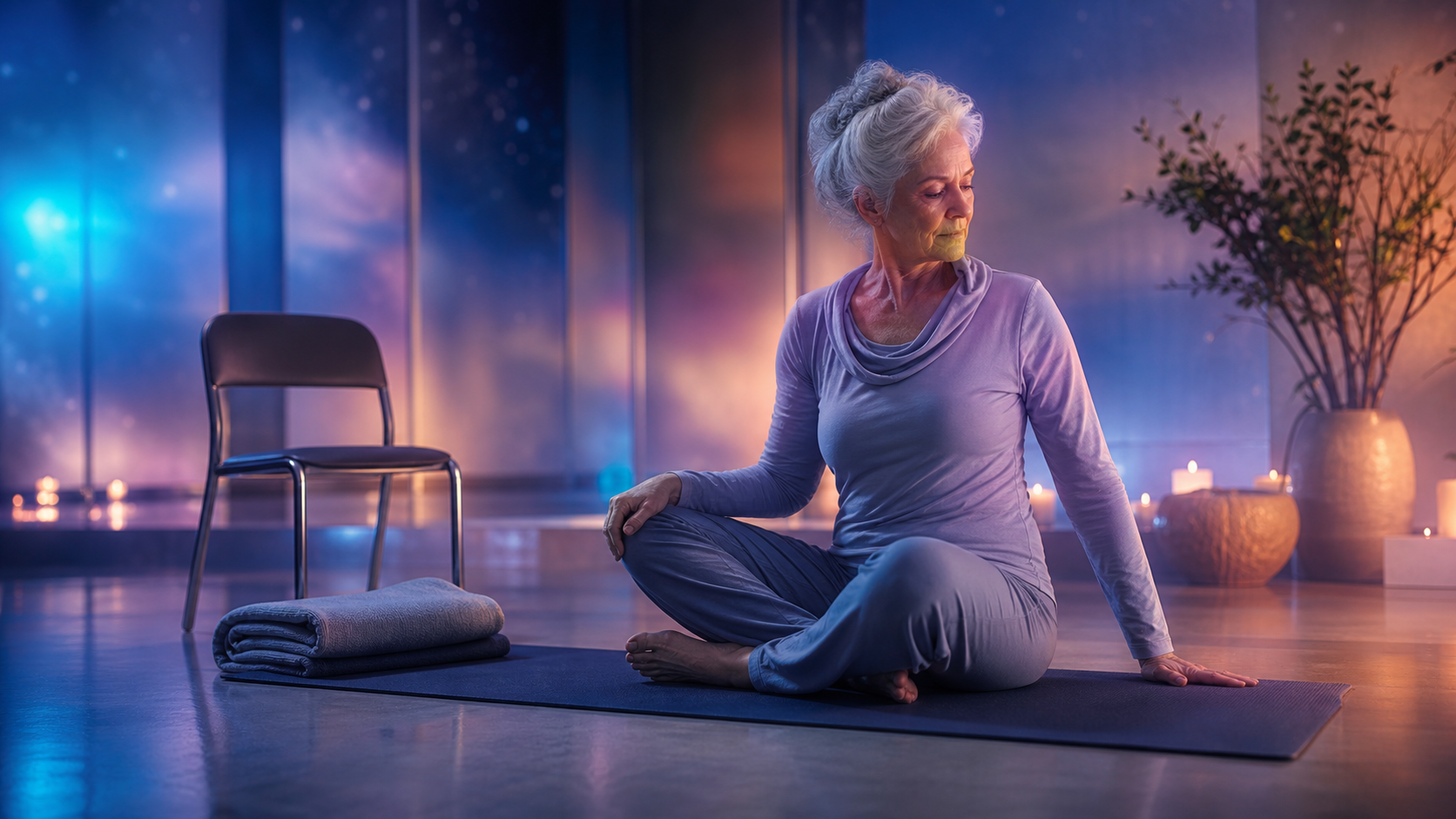
If I were helping a 70-year-old parent, an aunt with a knee replacement, or my future self choose a class, I would start with the boring words: gentle, beginner, chair, slow, supported.
Those words are not code for “older adults are fragile.” They describe a nervous-system problem. A class that moves quickly from plank to lunge to twist can become confusing when vision, hearing, reaction time, neuropathy, or joint pain are part of the picture. A slower class gives the brain time to map where the feet are, where the chair is, whether the right knee feels safe, and whether the breath has gone tight.
For many older beginners, the most approachable starting points in yoga for seniors are chair yoga, gentle hatha yoga, restorative yoga, and Iyengar-inspired classes that use props. In a senior center, “hatha” usually means a slower class built around basic postures rather than a fitness-style flow. “Chair yoga” means the chair is part of the practice, either for sitting or for balance support. Restorative yoga uses blankets, bolsters, and cushions in long holds to reduce muscular effort. Iyengar-style teaching, at its best, is careful about alignment and practical about blocks, straps, walls, and chairs.
The version I would usually avoid at the beginning is the one that makes a 72-year-old beginner feel late. Fast vinyasa, hot yoga, and power yoga ask more from balance, wrists, hydration, temperature regulation, and cardiovascular stamina. They are not forbidden forever. They are just not where I would send someone who spent the last decade at a desk, caregiving, or recovering from surgeries.
There is useful humility in starting with a first-month chair practice that looks smaller than the ego wants.
A systematic review and meta-analysis in the International Journal of Behavioral Nutrition and Physical Activity found that yoga was associated with improvements in physical function and health-related quality of life in adults 60 and older, with the authors noting that yoga was generally comparable or superior to inactive controls for several outcomes (Sivaramakrishnan et al., 2019). Another review focused on balance and mobility concluded that yoga had positive effects on balance and mobility in people over 60, although the authors also pointed out that the quality and size of studies varied (Youkhana et al., 2016).
That last word matters: varied. A chair class at the library, a YouTube stretch video, and a 90-minute heated flow are all called yoga. For a 68-year-old with osteoporosis or an 83-year-old who uses a cane, they are not the same dose, demand, or risk.
The right yoga for seniors class is often the one that leaves enough energy for groceries, stairs, dinner, and the rest of the day.
A chair is not a compromise in yoga for seniors
Some people see a chair in yoga and think, “That’s the easy version.”
A chair can make yoga for seniors more precise. It gives the hands a predictable place to land. It lets the spine lengthen without demanding that the knees fold like origami. It can make standing balance work less frightening, which means the person practicing can notice the left foot, right hip, and breath instead of bracing for a fall.
Fear changes movement. Anyone who has slipped on ice outside a pharmacy knows this. The body gets narrow. The breath gets shallow. The eyes stare down. A chair can interrupt that spiral. It says: you can explore this weight shift, and you have a way back.
Falls are not a small concern. The CDC reports that more than 1 in 4 older adults in the United States falls each year, and falling once doubles the chance of falling again (CDC, 2024). That does not mean yoga should become a fall-prevention program with incense. It means balance deserves the same respect as blood pressure, medication lists, and stair railings.
In a practical chair-based session of yoga for seniors, a person might begin seated with both feet on the floor, pressing the soles down and noticing whether the left heel or right forefoot feels heavier. The arms lift on an inhale and lower on an exhale. The shoulders roll slowly, not to chase flexibility, but to remind the upper back and ribs that they still participate in breathing. A seated twist might be small enough that nobody watching would be impressed. Good. The point is sensation without alarm, not spectacle.
From there, the chair can support standing work. Hands on the back of the chair, feet hip-width apart, a few slow heel raises. Then perhaps one foot steps back into a supported lunge, shorter than the version on a yoga poster. The front knee bends only as far as it feels trustworthy. The back heel can stay lifted. The spine stays tall. The breath keeps voting.
That supported lunge, with one chair and two cautious feet, can be yoga.
So is sitting down before fatigue turns balance sloppy. So is skipping the pose that makes the right hip feel pinched. So is using two chairs because one chair feels wobbly. Adaptation is not failure. It is often how intelligent practice survives contact with an actual body.
How often should a 70-year-old do yoga for seniors?
A practical answer is less glamorous than the question wants: enough to become familiar, gently enough to recover by the next morning.
For a healthy 70-year-old beginner, I like 10 to 20 minutes of yoga for seniors, three or four days a week, for the first month. That rhythm is not sacred. It is humane. It gives the joints, vestibular system, feet, and nervous system repeated exposure without turning yoga into another adult responsibility with a failure mode.
The WHO’s physical activity guidance for older adults supports regular weekly movement that includes balance and strength work, rather than occasional heroic efforts (Bull et al., 2020). Yoga can contribute to that, especially if the practice includes standing poses, slow transitions, supported balance, and leg work such as sit-to-stand repetitions.
But “daily yoga” is not automatically better for a 70-year-old shoulder, spine, or nervous system. A ten-minute seated practice after breakfast can be useful. A 60-minute class that leaves someone wiped out for two days may be too much. The older body is not worse at movement, but it can be less forgiving of sudden changes in volume, heat, or intensity.
I think of the first few weeks of yoga for seniors as a negotiation between the calendar and the body.
The body says, “My right shoulder does not like that overhead angle.”
The practice says, “Fine. We can turn the palm inward and stop at shoulder height.”
The body says, “Getting down to the floor is not worth it today.”
The practice says, “We have a chair and a wall.”
The body says, “I can do more.”
The practice says, “Maybe tomorrow, after we see how the knees feel tonight.”
That chair-and-shoulder conversation is the work.
A useful weekly pattern might include two short chair or gentle sessions at home, one longer class with a skilled teacher, and one night where the only “yoga” is breathing with one hand on the belly before bed. If walking, swimming, physical therapy, or strength training are already in the week, yoga does not need to take over. It can be the hinge that makes the other movement feel better.
The trap is starting with a fantasy schedule. Every January, people of every age create a plan that assumes sleep will be perfect, knees will be cooperative, caregivers will not call, and life will not interrupt. Then the plan breaks, and they decide they are undisciplined.
Start with ten honest minutes. Let the fantasy schedule lose to the sturdy chair.
The poses that earn their place in yoga for seniors
I do not love long lists of “best poses for seniors,” because the best pose depends on the person in front of you. A 68-year-old cyclist with a new hip has different needs from an 83-year-old who uses a walker. Still, some shapes appear again and again in yoga for seniors because they solve ordinary problems: standing, sitting, reaching, turning, and recovering balance after a misstep.
The first is mountain pose, which is just standing with attention. It sounds almost insulting until you try it. Feet planted. Knees soft. Ribs resting over the pelvis. Chin level. If balance is uncertain, the chair sits in front of the body, close enough to touch. In mountain pose, the work is not to “stand up straight” like a scolded child. The work is to feel the floor and let the ankles, hips, spine, and eyes organize around it.
Then comes the sit-to-stand, which yoga people disguise as chair pose. I prefer the plain name. Sit in a firm chair. Place both feet under the knees. Lean forward slightly and stand without rushing. Sit back down with the same care. This is daily-life strength. It is the movement behind getting out of a dining chair, off a toilet, and out of a waiting-room seat when your name is called.
Supported tree pose can be beautiful when it is stripped of drama. One hand on the chair. Weight shifts into the left foot. The right heel lifts, with toes still touching the floor. That can be the whole pose. If balance feels steady, the right foot can rest against the inner left ankle or calf, never jammed into the knee. The eyes stay on one point. The jaw unclenches. Five breaths is plenty.
A seated cat-cow is another keeper in yoga for seniors. Sit toward the front of the chair. Hands rest on thighs. On the inhale, the chest broadens and the spine gently arches. On the exhale, the back rounds and the belly softens. It is a way to bring movement to the ribs and thoracic spine after hours of sitting, not a performance of spinal flexibility.
For the hips, a seated figure-four stretch can help, if the knees allow it. One ankle crosses over the opposite thigh. The foot stays flexed. The spine stays long. If the hip says no, the pose is skipped. There is no prize for arguing with cartilage.
For the calves and ankles, supported heel raises and toe lifts do more than they appear to do. They wake up the lower legs, which matter for walking, stair climbing, and balance corrections. For the shoulders, arms can slide up a wall or reach forward with a strap held between the hands. Small is still real.
The floor is optional. If getting down and up from the mat is safe, a supported bridge or knees-bent rest can feel wonderful. If it is not safe, the chair version is not second-best. It is the practice for that body on that day.
What yoga for seniors can and cannot do
Yoga attracts big claims. Some are sincere. Some are nonsense with soft lighting and a stock photo of a beach.
Here is the grounded version: yoga for seniors may help some older adults improve balance, mobility, strength, mood, sleep, and pain perception, depending on the style, teacher, frequency, and person. It is not a cure-all. It is not a replacement for medical care, physical therapy, medication, or a walker when one is needed. It is a practice with a growing, imperfect evidence base.
A 2014 review in JAMA Internal Medicine found that mindfulness meditation programs had moderate evidence for improving anxiety, depression, and pain, with smaller or insufficient evidence for other outcomes (Goyal et al., 2014). That paper was about meditation rather than yoga postures, but it matters here because many senior yoga classes include breathing and attention practices. The quiet part of yoga is not decoration. If the breath is the piece you are most interested in, it can also help to have a separate, simple guide for how to calm down when the body feels keyed up.
For back pain, a Cochrane review reported that yoga produced small to moderate improvements in back-related function compared with non-exercise controls, while also noting that yoga was associated with more adverse events than non-exercise controls, most commonly increased back pain (Wieland et al., 2017). That is the adult conversation yoga for seniors needs. Yoga may help a back. Yoga can also irritate a back. Both are true.
On stress physiology, a review of yoga, mindfulness-based stress reduction, and stress-related biomarkers found evidence of reductions in some stress markers, including cortisol in several yoga studies, while the authors emphasized differences in study design and intervention type (Pascoe et al., 2017). So if someone asks whether yoga can lower cortisol, the clean answer is: it has in some studies, but it is not a guaranteed switch you flip. For a broader, non-yoga approach, here is a practical guide on how to deal with stress.
For cognition, a randomized trial of eight weeks of hatha yoga in older adults found improvements in executive function measures compared with a stretching-strengthening control group (Gothe et al., 2014). That does not mean yoga prevents dementia. It means that structured movement with attention may be doing something interesting for the aging brain, and it deserves serious study without hype.
One meaningful benefit, though, is less measurable than a timed up-and-go test. Yoga for seniors can give older adults a structured way to listen to the body without treating every sensation as danger. That skill matters. Pain can make the world smaller. So can fear of falling. So can the quiet embarrassment of not being able to do what used to be easy.
A good chair, a clear breath, and five trustworthy movements can widen the room again.
Safety is part of yoga for seniors
A risky yoga class is not always the hardest one. Sometimes it is a class where an older adult does not want to bother the teacher.
Older adults have spent decades being competent at jobs, families, money, caregiving, and emergencies. It can feel strange to say, “I need a different version.” Say it anyway. A teacher who cannot handle that sentence may not be the right teacher for yoga for seniors.
Certain conditions deserve extra care. Osteoporosis changes the conversation around deep forward folds and loaded twisting. Joint replacements can limit range of motion. Glaucoma can make long inversions inappropriate. Neuropathy can affect balance. Blood pressure changes can make quick transitions from floor to standing feel dicey. If you have a significant medical condition, recent surgery, unexplained dizziness, or liver cirrhosis, ask a clinician who knows your history what movement limits matter for you.
That medical boundary-setting is not boring caution. It is freedom. A person with osteoporosis, glaucoma, or a recent hip replacement can practice more confidently when the “do not do this” list is clear.
The safety literature is not a reason to panic, but it is a reason to be precise. A systematic review of adverse events associated with yoga found that most reported events were musculoskeletal, with risk linked to factors such as pre-existing conditions and strenuous practice (Cramer et al., 2015). Translation: the body brings its surgical history, arthritis, medications, and old injuries to the mat. Respect the history.
A simple safety rule in yoga for seniors is this: discomfort can be information, but sharp pain is a stop sign. Breath-holding is also a message. So is facial tension. So is the sudden need to prove something in a room full of strangers.
That last one, the need to prove something, has probably injured more honest knees than any chair ever has.
The senior who practices well is not the one who does the deepest pose. It is often the one who notices the first honest “no” from a hip, wrist, back, or breath and adjusts before the body has to shout.
The emotional work of beginning yoga for seniors late
There is a tenderness to starting yoga at 65, 72, or 84 that does not get enough attention.
Children fall constantly. They do not build a philosophy around it. Adults remember. Older adults remember with consequences. A fall can mean an injury, a hospital visit, a family meeting, a new cane, or a new level of surveillance from people who love you but also make you feel managed.
So when an older beginner stands on one foot with a chair nearby, the pose is not just physical. It is a negotiation with memory, fear, pride, and the last time the sidewalk won.
There can also be grief in the room. The shoulder that will not rotate like it used to. The spouse who is not there. The body that once ran, carried children, worked night shifts, shoveled snow, and climbed stairs without a second thought. Wellness culture likes to skip this part. It wants aging to be inspirational or invisible.
Yoga for seniors, when it is honest, makes room for the mixed feeling. You can be grateful for the body and irritated with it in the same breath. You can adapt a pose and still miss the old version of yourself. You can laugh when the chair squeaks. You can rest before you need permission.
That emotional permission is not a side benefit. It can be one reason a person returns to practice.
A first week of yoga for seniors that makes sense
If you are beginning yoga for seniors, begin in daylight. Use a sturdy chair that does not roll. Wear shoes if bare feet feel unstable. Clear the rug edge, the dog toy, the phone charger, and the small household traps that make balance practice more exciting than it needs to be.
Do less than your first-week enthusiasm thinks you can.
On the first day, sit and breathe for three minutes. Feel both feet. Let the exhale be a little longer than the inhale, not forced, just unhurried. Add shoulder rolls. Add a seated twist. Stand behind the chair and practice five slow heel raises. Sit down.
For day 1, that five-minute chair sequence is enough.
On the second or third day, repeat the same sequence and add a supported balance shape. On another day, try a gentle class designed for seniors, ideally with a teacher who mentions props before ambition. If you use a video, watch a minute before joining. The right teacher will sound calm, specific, and completely uninterested in pushing you past your good sense.
After a week, ask the only question that matters: do I trust this practice enough to return next week?
The question is not “Did I change my life?” or “Am I good at yoga?” Trust is the measure. Trust is what lets the body soften its guard around the chair, the floor, the breath, and the next small movement.
Yoga for seniors should not be sold as a miracle, because older adults have earned better than miracles. It should be offered as a practical ritual: a chair, a breath, a few careful movements, and the radical idea that the body you have now is still worth knowing.
If you want a quiet place to start before adding poses, open Slowdive and use the 10-minute guided body scan. Pair it with a chair, both feet on the floor, and let that be today’s practice. When you’re ready to find a practice that fits your day, Find your meditation match.
FAQ
What is the safest type of yoga for seniors?
The safest yoga for seniors is usually gentle, slow, and supported. Chair yoga, beginner hatha, restorative yoga, and prop-based classes are often strong starting points because they reduce floor transitions, rushing, and unsupported balance. The right class should leave an older adult feeling steadier and more aware, not exhausted, embarrassed, or sore for days afterward.
How often should beginners practice yoga for seniors?
A reasonable start is 10 to 20 minutes, three or four days a week, especially during the first month. Yoga for seniors often works best when the body has time to become familiar with the movements. Short, repeatable sessions usually beat one ambitious 60-minute class that takes two days to recover from.
Can yoga for seniors help with balance?
Yes, yoga for seniors can support balance when it includes slow transitions, standing poses, chair support, and attention to the feet. The chair matters because it can reduce fear. When the body feels safer, an older adult can practice weight shifting, ankle control, and steadiness without bracing for a fall.
Should older adults use a chair during yoga?
Yes, if it helps. A chair in yoga for seniors is not a sign of weakness. It can make standing work more precise, support balance, and make the practice possible on days when the floor feels unrealistic. A sturdy, non-rolling chair is usually the best choice.
Are floor poses necessary in yoga for seniors?
No. Floor poses are optional in yoga for seniors. If getting down and back up is safe, supported floor work such as knees-bent rest or bridge can feel good. If it is not safe, seated and standing chair-based movements can still build awareness, strength, mobility, and confidence without turning the practice into a struggle.
How can someone start yoga for seniors at home?
Start with daylight, a sturdy chair, clear floor space, and a very small plan. Sit with both feet down, breathe for three minutes, add shoulder rolls, try a seated twist, then stand behind the chair for five slow heel raises. That can be a complete first home practice.
Slowdive is a calm-tech companion — guided meditations, breathing practices, and sound therapy crafted for everyday balance.