
Coherence breathing: the 5-minute calm practice


Coherence breathing is a 5-minute paced-breathing practice: inhale for 5 seconds, exhale for 5 seconds, and repeat at about 6 breaths per minute.
Coherence breathing is paced breathing at a steady tempo: most people start with a 5-second inhale, a 5-second exhale, and a 5-minute timer.
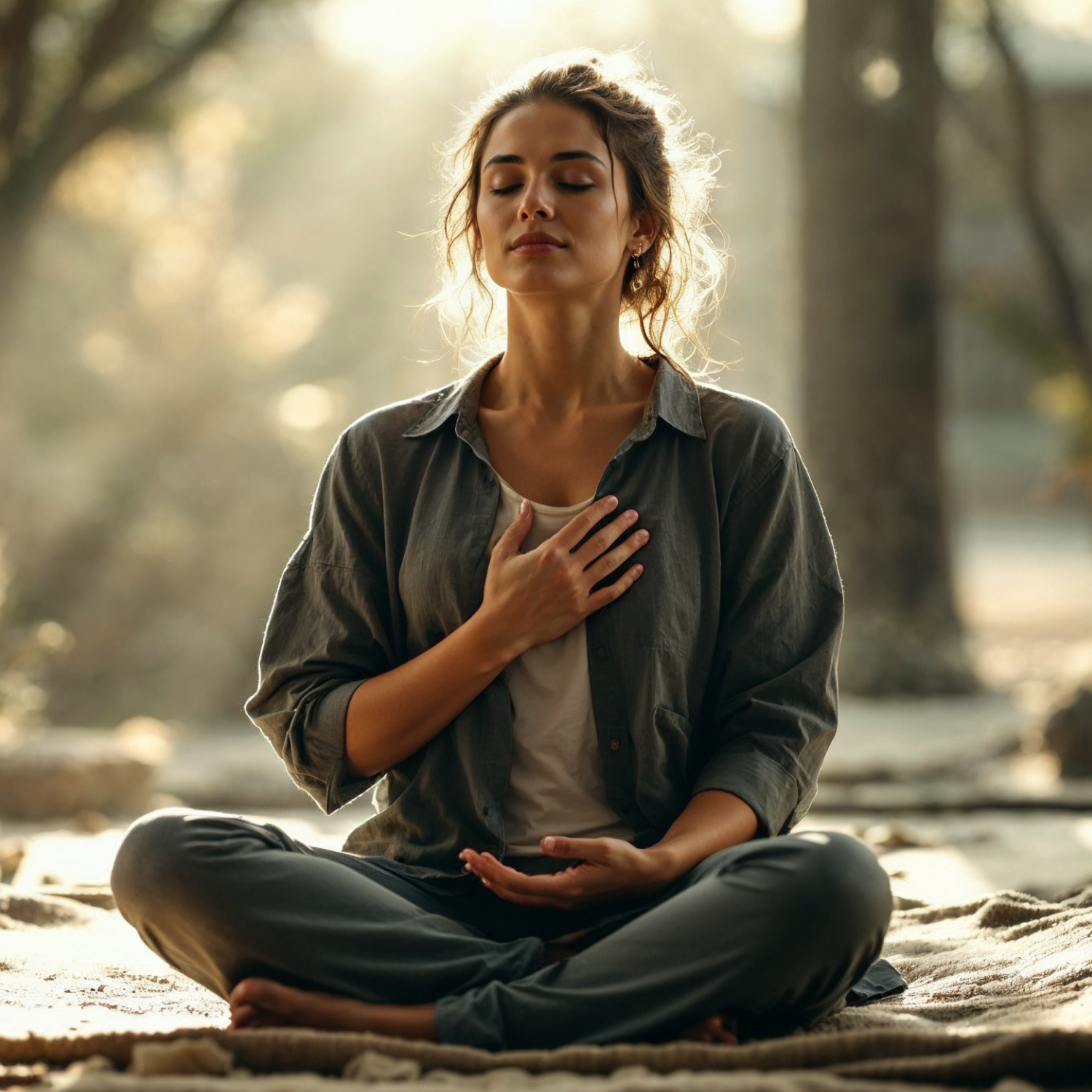
That 5-and-5 rhythm works out to 6 breaths per minute, a pace often used in heart rate variability training because it may give the cardiovascular system a predictable signal without asking you to “clear your mind.” The counterintuitive part: the goal is not a bigger breath, but a more repeatable one.
No incense, no special cushion, and no promise that your inbox will become less absurd. Just slow, even breathing at a rhythm your body can track.
Find your meditation match in 60 seconds
Understand what coherence breathing means

Coherence breathing, also called coherent breathing or cardiac coherence breathing, is a slow breathing practice where each inhale and exhale follows a steady count, usually around 5 to 6 breaths per minute.
The most common version is:
- Inhale for 5 seconds
- Exhale for 5 seconds
- Continue for 5 minutes
That creates 6 full breaths per minute. Some people prefer 4 seconds in and 6 seconds out. Others land closer to 5.5 seconds each way. You’ll also see nearby language like resonance breathing, especially when people mean breathing near a personal rhythm that produces a smooth heart-rate pattern.
The point is not to hit a sacred number. The point is to breathe slowly enough that the nervous system may receive a clean, repeating signal instead of a jagged series of sighs, gasps, and breath holds.
If meditation feels too slippery, coherence breathing gives you a physical job. You don’t have to “clear your mind.” You count to 5, breathe, and start again when you lose track.
You will probably lose track during minute 2 or minute 3. That’s part of the practice, not evidence that you failed it.
Notice why rhythm changes the breath
Most advice to “take a deep breath” arrives at the worst possible time: when you’re irritated, panicked, or trying not to cry in a bathroom stall at work.
One huge chest inhale can tighten the neck, drop carbon dioxide too quickly, and make an already activated body feel more buzzy.
Coherence breathing may work differently because the rhythm is a key part of the intervention. A smooth 5-second inhale and 5-second exhale may give the lungs, heart, and blood-pressure reflexes a pattern to synchronize with.
The science centers on the autonomic nervous system, which regulates heart rate, breathing, blood pressure, and digestion without conscious micromanagement. Slow breathing practices have been linked with changes in heart rate variability, baroreflex function, and parasympathetic activity in a 2018 systematic review by Zaccaro and colleagues in Frontiers in Human Neuroscience (Zaccaro et al., 2018).
That does not mean one 5-minute session “resets” your nervous system like rebooting a laptop. Bodies are not laptops, and stress physiology does not run on a power button.
Breathing rhythm can still feed useful information into systems already built to listen. During slow breathing, the heart rate tends to rise slightly on the inhale and fall slightly on the exhale, a pattern called respiratory sinus arrhythmia.
A helpful phrase here is heart rate variability, or HRV: the natural variation in time between heartbeats, often measured in milliseconds.
Higher HRV is not automatically “better” in every context, but HRV is used as one marker of flexible nervous system regulation.
Plainly: when your breath becomes steady for 5 minutes, your heart rhythm often becomes more orderly too.
Try coherence breathing for five minutes

Set a timer for 5 minutes. Sit upright, or stand if you’re trying not to fall asleep. Let both feet touch the floor so your body has a simple orientation point.
Start here:
- Inhale through your nose for 5 seconds.
- Exhale through your nose or mouth for 5 seconds.
- Keep the breath smooth, not heroic.
If 5 seconds feels strained, shorten the count to 4 seconds in and 4 seconds out.
If you’re gasping by the third round, you’re working too hard.
The breath should feel like a tide, not a gym set.
It can help to take one normal breath before counting. That prevents the first inhale from becoming a “wellness performance” breath.
Then count quietly:
In, 2, 3, 4, 5.
Out, 2, 3, 4, 5.
As a 5-minute breathing exercise, coherence breathing can work partly because the instructions stay boring in the best way. After about 60 seconds, the counting may become less verbal.
You’ll feel the timing. Then your mind may wander to whether you replied to that email from finance.
Fine. Come back at the next inhale.
Don’t scold yourself; scolding ruins more 5-minute practices than laziness ever has.
Choose where to put your attention
Some coherence breathing instructions suggest focusing on the heart area while you breathe. If that cue helps, use the center of the chest as your attention point.
Imagine the breath moving in and out of the sternum area, even though the air is physically moving through the nose, throat, and lungs.
If that feels too abstract, choose a sensory anchor instead:
- The coolness at your nostrils as you inhale
- The softening of your ribs as you exhale
- The feeling of your hands resting in your lap
- The visual rise and fall of a breathing guide
The ribs can be a useful anchor because they give immediate feedback. You can feel when you’re forcing the inhale, lifting the shoulders, or dumping the exhale.
What you don’t need is a perfect mental image. Beginners often get tangled in the visualization.
They wonder if they’re “doing it right” because they can’t imagine breath moving through the heart, or because their mind keeps narrating the day.
If you are breathing slowly and evenly without strain for several rounds, you’re doing coherence breathing.
Use coherence breathing for everyday stress
Underpromise and let the 5-minute practice show up in ordinary situations.
Coherence breathing can be useful as a short calming ritual before a staff meeting, after a tense conversation, or during the awkward middle of the afternoon when your body wants caffeine but your nerves disagree.
If you searched for breathing for stress because your day is already loud, this is a reasonable place to begin because the technique has only 2 moving parts: a steady inhale and a steady exhale.
For stress and anxiety symptoms, the closest body of evidence comes from slow breathing and HRV biofeedback rather than coherence breathing as a single branded method. A 2017 meta-analysis by Goessl, Curtiss, and Hofmann found that HRV biofeedback was associated with reductions in self-reported stress and anxiety across controlled studies (Goessl et al., 2017).
HRV biofeedback usually involves paced breathing plus a sensor that shows heart-rhythm feedback, so it is not identical to sitting at your desk with a timer. The overlap matters because both methods use breathing pace to influence cardiorespiratory rhythm.
A 2023 randomized study by Balban and colleagues in Cell Reports Medicine compared 5 minutes a day of breathwork with mindfulness meditation over one month. The breathwork groups reported greater improvements in positive affect than the mindfulness group, and the cyclic sighing group showed the largest daily mood improvement (Balban et al., 2023).
That study tested specific breath patterns, not classic 5-in, 5-out coherence breathing, so it should not be treated as proof for this exact practice. It is better read as evidence that 5 minutes of structured breathing may be meaningful for some people.
In practice, that matters because a repeatable 5-minute routine is often easier to sustain than the beautiful 45-minute routine you abandon by Wednesday.
Practice before stress starts to peak
Coherence breathing often works best when you practice before you desperately need it.
That sounds unfair. The whole reason people search for breathing exercises is because their body already feels like a 9 out of 10.
Use coherence breathing now if you need to. But if you only practice when your body is already flooded with adrenaline, you’re asking a new skill to perform under stadium lights.
Try it at boring times first.
Before opening your laptop.
In the car after parking.
Right after lunch.
At the end of your workday, before you bring work residue into your kitchen.
Five minutes is short enough to fit between calendar blocks and may be long enough for your body to register the repeated 6-breaths-per-minute rhythm.
Slowdive is a calm-tech companion — guided meditations, breathing practices, and sound therapy crafted for everyday balance.
One minute may take the edge off. Five minutes gives the rhythm more time to become obvious.
The popular “365” version of cardiac coherence uses 3 sessions a day, 6 breaths per minute, for 5 minutes. The structure can help, but 15 minutes a day may be too much to start with if you’re already overwhelmed.
Start with once a day for 7 days. Tie it to something you already do, like making coffee or closing your laptop.
Tiny hinges. Big doors.
Avoid mistakes that make breathing harder
The first mistake is breathing too deeply.
Coherence breathing is a slow breathing technique, not maximum-capacity breathing. If your chest is heaving, your neck muscles are working, or you feel lightheaded, reduce the volume of the inhale.
Let the inhale be medium-sized. Let the exhale leave without a push.
The second mistake is turning the count into a test. You don’t get extra credit for perfect 5.000-second breaths.
If the count makes you tense, use a visual pacer, a metronome set near 6 breaths per minute, or soft music with a slow rhythm.
The third mistake is expecting instant emotional silence. Your mind can keep talking while your body settles.
That’s allowed. Calm is not always a feeling at first.
It can show up as one unclenched jaw muscle, one less reactive email, or the decision to take a 10-minute walk instead of picking a fight with your calendar.
Those adjustments are not just about comfort. They help keep the practice gentle, which is the main safety rule.
Is coherence breathing safe for you?
For most healthy adults, gentle paced breathing is low-risk. The key word is gentle.
Stop if you feel dizzy, numb, tingly, or short of breath. Those can be signs that you’re overbreathing, even if the breath is slow.
People with asthma, COPD, fainting episodes, significant heart rhythm issues, or panic symptoms that worsen with breath focus should get guidance from a qualified healthcare professional before making breathwork a daily practice.
Also, don’t practice while driving. It sounds obvious until someone pairs calm breathing with a commute.
Keep your eyes and attention on the road.
If breath awareness makes you anxious, keep your eyes open and focus on the room. Name a few ordinary objects while you breathe: chair, lamp, window.
Your nervous system may prefer a little outside-world contact, especially during panic or trauma-related activation.
Compare coherence breathing with other patterns
Box breathing usually uses equal parts inhale, hold, exhale, hold. A common pattern is 4 seconds in, 4 hold, 4 out, 4 hold.
Box breathing can feel steady and contained, especially for people who like structure and tolerate breath holds well.
4-7-8 breathing uses a 4-second inhale, 7-second hold, and 8-second exhale. Some people find the long exhale soothing because it slows the pace and extends the release.
Some people find the 7-second hold uncomfortable, especially during anxiety or air hunger.
Coherence breathing is simpler because there are no holds. That can make it a good first practice for anxious beginners.
The breath keeps moving. You don’t have to brace.
If you already love box breathing, keep it. If breath holds make you feel trapped, coherence breathing can be kinder.
Start with a simple 7-day experiment
Don’t overhaul your life. Run a 7-day experiment.
For the next week, choose one daily anchor. After you brush your teeth in the morning, or before your first meeting, do 5 minutes of coherence breathing.
Use this rhythm:
- Days 1 and 2: 4 seconds in, 4 seconds out
- Days 3 and 4: 5 seconds in, 5 seconds out
- Days 5 to 7: choose the rhythm that felt best
At the end of each session, write down one number from 1 to 10: how activated do I feel right now?
That’s it. No journaling essay required.
The number is a breadcrumb, not a diagnosis. After 7 days, you may notice the practice helps most before meetings, evening sessions make you sleepy, or 4-second breathing feels better than 5.
Good. Personal data can be more useful than borrowed rules.
Over time, small feedback makes the practice feel less like a technique and more like a usable part of the day.
Trust the power of doing less
Coherence breathing is appealing because it doesn’t ask for a personality change. You can be skeptical.
You can be busy. You can be the kind of person who gets annoyed when someone says “just breathe.”
Do it anyway, plainly.
Sit down. Set 5 minutes. Inhale gently. Exhale gently. Repeat.
Some days, coherence breathing will feel calming. Some days, it will feel like nothing happened.
That’s normal for a practice that seems to work by repetition rather than drama.
If you want coherence breathing structure, open the Slowdive app and use the guided breathing timer to set a 5-second inhale, 5-second exhale, and 5-minute session. Let the visual cue count for you.
If you want another short option, try these breathing exercises for calm too.
And when you’re ready to find a practice that fits your day, Find your meditation match.
Answer common coherence breathing questions
What is coherence breathing?
Coherence breathing is a paced breathing practice, usually around 5 to 6 breaths per minute. The simplest version is inhaling for 5 seconds and exhaling for 5 seconds.
The goal is a steady, comfortable rhythm, not a dramatic deep breath or a perfect performance.
How often should I practice coherence breathing?
Start with once a day for 7 days. Five minutes is often enough to learn the rhythm without making the practice feel like another chore.
If it helps, add a second session later, especially before predictable stress points like meetings, commuting transitions, or bedtime.
Why use five-second breaths?
A 5-second inhale and 5-second exhale creates about 6 breaths per minute, a pace used in slow breathing and HRV biofeedback practices. It is not sacred math.
If 5 seconds feels strained, shorten the breath to 4 seconds and keep it smooth.
Can coherence breathing help during anxiety?
Coherence breathing can help some people feel steadier because it gives the body a repeating, predictable pattern. During high anxiety, keep the breath gentle and your eyes open if needed.
If focusing on breathing makes panic worse, use grounding through sight, sound, or touch instead.
Should I do coherence breathing before sleep?
You can try coherence breathing before sleep, especially if your body feels wired but tired. Keep the count easy and quiet, without chasing a result.
Some people get sleepy after 5 minutes; others simply feel less activated. If coherence breathing makes you too alert, move it earlier in the evening.
Curious about where to begin? A short check-in maps your stress baseline and suggests a personalised practice plan.