
Wim hof breathing technique: a practical guide


The Wim Hof breathing technique can feel powerful for some people because it deliberately changes carbon dioxide, breath-hold tolerance, and arousal. It can also feel like too much if you treat it like a casual relaxation exercise. Beginners deserve the plain version: what it is, what it may feel like, what the current science suggests, and how to try it without turning your living room into a stunt.
Slowdive is a calm-tech companion — guided meditations, breathing practices, and sound therapy crafted for everyday balance.
Find your meditation match in 60 seconds
First, what is the Wim Hof breathing technique?

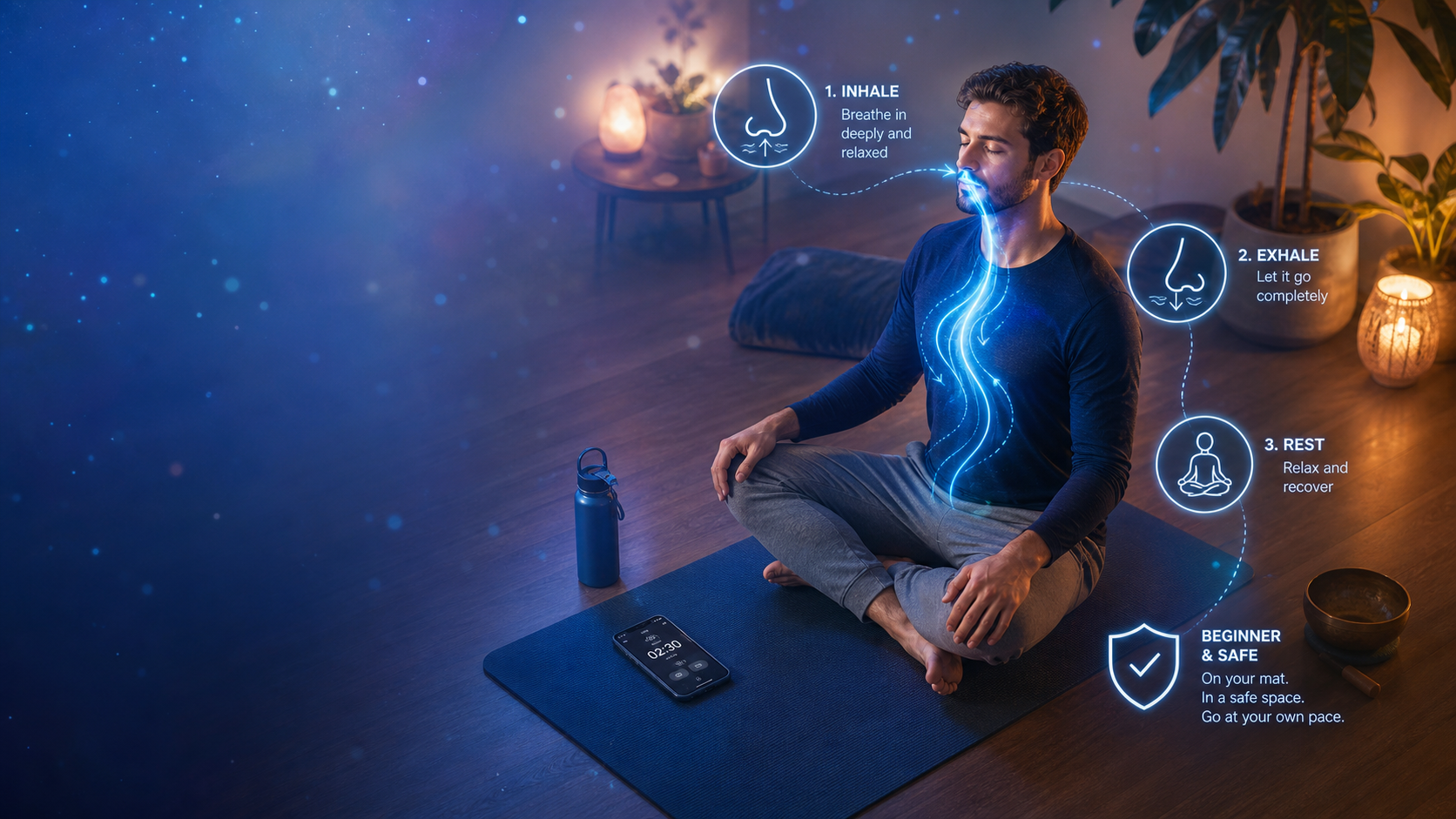
The Wim Hof breathing technique is a breathwork protocol built around repeated rounds of deep, rhythmic breathing followed by exhale breath holds. It sits inside the wider Wim Hof Method, which also includes cold exposure and mindset training, according to the official Wim Hof Method site (Wim Hof Method, breathing exercises).
A typical round of the Wim Hof breathing technique looks like this:
- Take 30 to 40 deep breaths.
- After the final exhale, hold the breath out.
- When you feel the urge to breathe, inhale fully.
- Hold that inhale for around 10 to 15 seconds.
- Exhale and begin another round.
That 30-to-40-breath template is the basic shape, but different Wim Hof guides vary the pacing, number of breaths, length of retentions, and number of rounds.
The Wim Hof breathing technique is better understood as a strong respiratory stimulus than as quiet meditation.
The breathing phase may make you feel charged, tingly, emotional, lightheaded, clear, uncomfortable, or several of those sensations in the same five-minute session. Some people enjoy the sympathetic jolt. Some people don’t. Both reactions make sense.
A common beginner mistake is assuming “breathwork” means “gentle.” This particular Wim Hof style asks your body to shift carbon dioxide, oxygen tolerance, and nervous-system state quickly.
What’s happening in the body during the Wim Hof breathing technique?
During the fast, deep breathing phase of the Wim Hof breathing technique, you blow off more carbon dioxide than usual. Lower carbon dioxide can raise blood pH and may contribute to tingling, dizziness, muscle twitching, and lightheadedness, according to StatPearls’ clinical review of respiratory alkalosis (Patel and Sharma, 2023).
That doesn’t mean finger tingling is dangerous by itself. It does mean the sensation has a physiological basis. You’re not “detoxing.” You’re changing breathing chemistry through hypocapnia, which means reduced carbon dioxide in the blood.
Then comes the breath hold. After you exhale and hold, oxygen levels gradually drop until the urge to breathe returns. In the Wim Hof Method research literature, the practice is described as cycles of hyperventilation followed by breath retention, with cold exposure included as part of the broader method (Almahayni and Hammond, 2024).
This carbon-dioxide-and-oxygen swing is why safety matters. A practice that can make you lightheaded should not be done in water, while driving, standing, or anywhere fainting would be dangerous. The official Wim Hof Method safety guidance also warns against practicing in water or while operating a vehicle (Wim Hof Method, safety information).
The water-and-driving warning is not decorative; it can be the difference between a controlled breathwork session and a preventable accident.
How the Wim Hof breathing technique feels the first few times
A beginner session is often less mystical than Instagram makes it sound.
You lie down. You breathe more deeply than usual. Around breath 15, your hands may become hard to ignore. Around breath 25, your thoughts may get louder or quieter. The exhale hold can feel peaceful for 20 seconds, then suddenly urgent when carbon dioxide rises and the breathing reflex returns.
A few common sensations:
- Tingling in the fingers, lips, face, or feet
- Warmth in the chest or belly
- Lightheadedness
- Emotional release, including laughter or tears
- A strong urge to swallow or breathe during the hold
- A floaty calm after the final recovery breath
None of those sensations prove that you’re doing the Wim Hof breathing technique “right.” They are sensory feedback from breathing volume, carbon dioxide changes, attention, and breath retention.
Be especially careful with the idea that a long breath hold equals progress. It’s tempting to turn the timer into a scoreboard: one minute today, 90 seconds tomorrow, two minutes by Friday.
The retention-scoreboard mindset can distort the practice.
For beginners, the better question is specific: did I stay aware, safe, and honest about what I felt during this round?
How to do Wim Hof breathing as a safe beginner version
If you’re new to the Wim Hof breathing technique, start smaller than your ego wants. A first session can be one to three rounds, with 25 to 30 breaths per round instead of chasing the full 40.
Set up
Lie down on a bed, couch, yoga mat, or carpet. Sitting may be fine if you’re stable, but lying down is usually better for session 1 because dizziness or faintness has less consequence. Don’t practice in the bath, pool, sauna, car, or shower. Don’t combine Wim Hof breathing with alcohol or recreational drugs.
If you are pregnant, have epilepsy, have a history of fainting, or have a significant heart, blood pressure, or respiratory condition, consult a healthcare professional before trying this kind of breathwork. The official Wim Hof safety page lists several groups who should avoid practicing (Wim Hof Method, safety information).
Round 1
Take 25 to 30 deep breaths.
Breathe in through the nose or mouth. Let the breath out without forcing it. Don’t clamp the exhale. Don’t strain the inhale. Think “full inhale, soft exhale” rather than “maximum effort.”
After the final exhale, hold the breath out.
When the urge to breathe becomes clear, inhale fully and hold for 10 seconds.
Exhale. Pause. Notice whether you feel steady, buzzy, calm, anxious, warm, or lightheaded.
Rounds 2 and 3
If round 1 felt steady, do one or two more rounds. If round 1 felt unpleasant or panicky, stop there. A single safe round still counts as practice.
A beginner does not need four rounds, five rounds, or “Wim Hof breathing 10 rounds” because a search bar suggested it. More rounds mean more respiratory stimulation, not automatically more benefit.
After your last round, stay lying down for two minutes. Breathe normally. Let the nervous system settle before you stand.
That two-minute recovery matters. The session doesn’t necessarily end when the YouTube guide ends. It ends when you can stand up without feeling wobbly.
What does the science say about the Wim Hof breathing technique?
The most famous Wim Hof Method study was published in Proceedings of the National Academy of Sciences in 2014. In that experiment, 12 healthy volunteers trained in meditation, breathing techniques, and cold exposure were injected with a bacterial endotoxin, then compared with 12 untrained controls. The trained group produced more epinephrine, showed lower levels of some inflammatory markers, and reported fewer flu-like symptoms than controls (Kox et al., 2014).
The 2014 endotoxin result is notable because it showed measurable changes in sympathetic nervous system activity and immune-response markers under laboratory conditions.
It is also small, highly specific, and not the same as showing that a beginner doing a YouTube breathing session at home will improve immunity, cure anxiety, or become resistant to illness.
A 2024 systematic review looked at the evidence for the Wim Hof Method and concluded that the current research is promising but limited, with small samples, mixed protocols, and a need for stronger studies (Almahayni and Hammond, 2024).
That 2024 review is the sober read.
There is enough evidence to take the Wim Hof breathing technique seriously as a physiological intervention. There is not enough evidence to treat online benefit lists as established fact.
If a page tells you the Wim Hof breathing technique will fix sleep, melt fat, erase depression, and turn you into a productivity machine, it is reasonable to close the tab before the claim stack gets any taller.
So why do people like it?
People often like the Wim Hof breathing technique because it can create a noticeable state shift within minutes.
That rapid shift is the honest answer.
A lot of wellness practices are subtle at first. Ten minutes of mindfulness can feel like sitting with your own unfinished email drafts. Gentle breathing at six breaths per minute can feel too quiet for someone whose body is running hot.
The Wim Hof breathing technique is different. You may feel the respiratory change quickly.
For people dealing with abstract stressors such as deadlines, messages, meetings, finances, or performance pressure, an intense breathwork session can make body sensations feel more concrete and easier to track.
The practice gives the mind a physical target to follow.
That doesn’t make Wim Hof breathing better than slower breath practices. It makes it more intense. Some mornings, that intensity may feel clarifying. Other mornings, especially if you’re already shaky or over-caffeinated, it can feel like pouring espresso into espresso.
Beginners should learn the difference between “clarifying intensity” and “too much stimulation” during the first week, not after a scary session.
Wim Hof breathing technique and anxiety
People often search for the Wim Hof breathing technique because they want relief from anxiety. A strong breathing practice can sound appealing when the chest feels tight and thoughts are looping.
The catch is mechanical: the sensations produced by fast breathing can resemble anxiety sensations. Tingling, lightheadedness, chest movement, a racing feeling, and breath hunger can all show up during the practice. Low carbon dioxide from overbreathing is associated with dizziness and tingling in respiratory alkalosis (Patel and Sharma, 2023).
For some people, feeling those sensations in a controlled setting may be empowering. For others, the same hypocapnia sensations can trigger panic.
If you’re prone to panic attacks, do not start with the Wim Hof breathing technique on a chaotic weekday morning. Start with slower practices first: box breathing, extended exhales, or a simple five-minute body scan. If you want a quieter comparison, coherence breathing is a good place to start.
If you do try the Wim Hof breathing technique, use a short session. One round. Lying down. No breath-hold heroics. Keep your eyes open if that feels safer. Stop before you feel overwhelmed.
The goal is not to win against your nervous system. The goal is to build trust with it, one controlled round at a time.
What about cold exposure breathing and cold showers?
The broader Wim Hof Method includes cold exposure, but you don’t need to take an ice bath to learn the Wim Hof breathing technique. In the 2014 Kox experiment, participants were trained in multiple components, including cold exposure, meditation, and breathing, so that study does not isolate breathing alone as the only active ingredient.
That multi-component design can get lost online.
If you breathe for ten minutes and then blast yourself with cold water, you may feel incredible afterward. You may also feel dizzy, stressed, or wiped out. Beginners should separate the variables so they know whether the reaction came from breathwork, cold exposure, caffeine, or the combination.
Try the Wim Hof breathing technique on its own first.
On another day, try a short cool finish to your shower if you’re curious and medically safe to do so. Keep it mild. Ten or 20 seconds of cool water is enough for a first experiment. You don’t need to perform toughness in your bathroom at 6:30 a.m.
Do not do breath holds in cold water, under a shower stream, in a pool, or in a bathtub.
Common beginner mistakes
Doing it in the wrong place
Curious about where to begin? A short check-in maps your stress baseline and suggests a personalised practice plan.
A lower-risk place for Wim Hof breathing is boring: lying on the floor, bed, or yoga mat.
Not in the bath. Not standing in the shower. Not before diving into a pool. Not while driving. Not perched on a kitchen stool because a three-minute clip made you feel inspired.
If the Wim Hof breathing technique can make you dizzy, respect the setting before you start round 1.
Forcing the breath
You don’t need to gasp like you’re trying to inflate a mattress. Full breathing is enough. If your throat tightens or your shoulders start working hard, soften the inhale and reduce the pace.
Many beginners turn the first 30 breaths into a respiratory workout. Then they wonder why they feel strained.
Use effort, not aggression.
Chasing long retentions
Breath holds vary from day to day. Sleep, caffeine, stress, menstrual cycle, recent exercise, and plain old mood can change your retention time.
If yesterday’s hold was 90 seconds and today’s is 45, nothing has necessarily gone wrong. Your body is giving you today’s number.
Take the 45-second signal without turning it into a failure story.
Skipping the recovery
The recovery breath after the hold is part of the Wim Hof technique. So is the quiet period after the final round.
Don’t jump up to answer a message. Don’t walk straight into a cold shower. Don’t treat the Wim Hof breathing technique like a pre-meeting hack you can cram between calendar alerts.
Give yourself two minutes afterward. That recovery window is where you find out whether the session left you clearer, shakier, calmer, or overstimulated.
A simple first-week plan for breathwork for beginners
Here’s one conservative way to introduce the Wim Hof breathing technique for a curious beginner.
Day 1: One round
Lie down. Do 25 to 30 breaths. Hold after the exhale until the urge to breathe is clear but not frantic. Take the 10-second recovery breath. Rest for two minutes.
Write down one sentence: “I felt…”
That one-sentence log is enough data for day 1.
Day 2: Rest or slow breathing
Skip the Wim Hof breathing technique. Try five minutes of slow nasal breathing instead. Make the exhale a little longer than the inhale, such as a four-second inhale and six-second exhale.
This day-2 contrast helps you compare intensity. You’re learning your own nervous system, not joining a club.
Day 3: Two rounds
If day 1 felt okay, try two rounds. Keep the same gentle attitude. No chasing retention times.
Afterward, rate the session from 1 to 5 for steadiness, not performance.
Day 4: Rest
Notice whether you’re craving the intensity of the Wim Hof breathing technique. Curiosity is fine. Compulsion is worth noting.
Day 5: Two or three rounds
Only add a third round if the first two rounds feel stable. If the second round feels like plenty, stop there.
Day 6: Try it at a different time
If you practiced in the morning, try late afternoon. If you practiced after coffee, try before coffee.
Caffeine can make body sensations feel louder. A simple breathing log can help you notice whether timing, caffeine, or other variables affect your response.
Day 7: Decide what role it plays
Ask a practical question: does the Wim Hof breathing technique help my day?
Not “did I have a wild experience?” Not “was my breath hold longer?” Ask whether the session leaves you clearer, steadier, and more able to move through the next hour.
If yes, keep the Wim Hof breathing technique as an occasional tool. If no, choose a gentler breath practice. There is no wellness medal for intensity.
Who should be cautious?
The Wim Hof breathing technique may not be the best starting point for everyone.
Be careful if you have a history of panic attacks, fainting, seizures, significant cardiovascular issues, uncontrolled high blood pressure, or respiratory conditions. Be careful if you’re pregnant. Be careful if you’re the kind of person who turns every body practice into a competition.
The official safety guidance for the Wim Hof Method advises against the practice for certain medical conditions and emphasizes not practicing in water or while driving (Wim Hof Method, safety information).
Extra caution is also reasonable during periods of grief, burnout, or severe sleep loss. Not because the Wim Hof breathing technique is “bad,” but because intensity can land differently when your nervous system is already stretched thin.
The safer choice during depleted periods may be the boring one: eat breakfast, take a walk, breathe slowly for five minutes, and go to bed on time.
Is Wim Hof breathing safe and healthy?
For some healthy adults, practiced safely and moderately, the Wim Hof breathing technique may be an interesting way to explore breath, attention, and stress physiology. The small 2014 endotoxin study showed that trained participants were able to voluntarily influence sympathetic nervous system activity and immune response markers under lab conditions (Kox et al., 2014). The 2024 review found the evidence base intriguing but not yet strong enough for sweeping claims (Almahayni and Hammond, 2024).
So “healthy” is the wrong first question.
Ask instead: is the Wim Hof breathing technique appropriate for me, today, in this setting, at this dose?
One round on a yoga mat before lunch is very different from five rounds in a bathtub. A curious beginner lying down is very different from a sleep-deprived person trying to force calm before a high-stakes meeting.
Context changes the practice.
A grounded way to approach it
The Wim Hof breathing technique is best treated as an experiment, not an identity.
You don’t need to buy the whole Wim Hof mythology to benefit from a few careful sessions. You don’t need to post your retention time. You don’t need ice floating in your tub. You don’t need to decide after one try whether the method is life-changing or nonsense.
Just gather data from the full arc of the session.
How do you feel before round 1?
How do you feel during the exhale hold?
How do you feel 20 minutes later?
That 20-minute question is the one beginners often forget. A practice can feel amazing during the peak and leave you edgy afterward. Or it can feel awkward during the session and quietly useful later. Pay attention to the whole arc.
If you’re using breathwork to support anxiety, focus, or emotional regulation, build a small menu. The Wim Hof breathing technique can be one option. Slow breathing can be another. A body scan can be another. Different days call for different tools.
A hammer is useful. You still don’t use it to wash a cup.
Final thoughts
The Wim Hof breathing technique is worth understanding because it can be potent and easy to underestimate. The beginner version is simple: lie down, do fewer rounds than you think you need, don’t force the breath, don’t practice in water, and stop if your body says stop.
The science is interesting, but young. The sensations are real, but not magical. The safety rules matter more than the streak.
If you want a gentler place to begin, open Slowdive and use the guided breathing timer for a short box breathing or extended-exhale session first. When you’re ready to find a guided breathing practice that fits your day, Find your meditation match. Then, if you try the Wim Hof breathing technique, use Slowdive’s post-session notes to track how you actually felt afterward. That record may teach you more than a retention timer will.
FAQ
What is the Wim Hof breathing technique supposed to do?
The Wim Hof breathing technique is meant to create a strong shift in breath, attention, and body state through deep breathing and breath holds. Some people use it for energy, focus, or stress exploration. It should be treated as an intense breathwork practice, not a casual relaxation shortcut.
How do you do Wim Hof breathing for the first time?
Start lying down somewhere safe. Take 25 to 30 deep breaths, hold after the final exhale until the urge to breathe is clear, then inhale fully and hold for about 10 seconds. Rest afterward. For a first session, one round of the Wim Hof breathing technique is enough.
Is Wim Hof breathing safe for anxiety?
The Wim Hof breathing technique can feel helpful for some anxious people, but it can also mimic panic sensations like tingling, lightheadedness, and breath hunger. If you are prone to panic, start with slower breathing first, keep the session short, stay lying down, and stop before you feel overwhelmed.
Can you do the Wim Hof breathing technique before a cold shower?
You can practice the breathing separately before experimenting with cold exposure, but do not do breath holds in water or under cold water. Beginners should separate the variables: try the Wim Hof breathing technique on its own first, then test a short cool shower finish on another day.
Should beginners use a guided breathing practice?
A guided breathing practice can help beginners keep a steady pace and avoid rushing, especially during the first few sessions. Choose a guide that emphasizes safety, lying down, and stopping when needed. If the guide pushes long retentions or toughness, pick something gentler.
Sleep stories, breathing routines, and curated sound healing tracks — built for evening wind-downs and morning resets.